


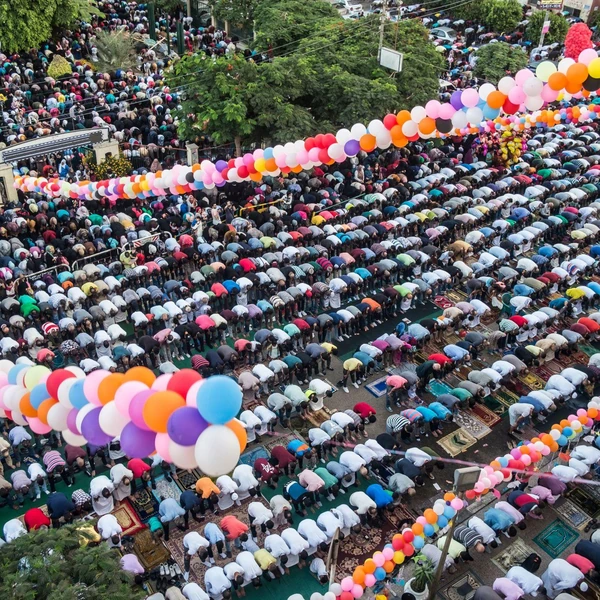
If you’re wondering how to pray Eid al Adha prayer, the basic method is easier to follow than it may first seem. Eid prayer consists of two rak‘ahs, includes extra takbirs, and is followed by the khutbah. There’s no adhan or iqamah. Below, we’ll walk through the prayer step by step and explain what happens before and after it.
What Is the Eid Al Adha Prayer?
Eid al-Adha prayer is the congregational prayer offered on the morning of Eid al-Adha, the Day of Sacrifice.
The Prophet ﷺ established prayer as the first major act of the day before the sacrifice. Al-Bara’ ibn ‘Azib reported that the Prophet ﷺ explained that they would begin the day by praying and then return to slaughter their sacrifices.
This order is clearly recorded in Sahih al-Bukhari 951.
So if you’re performing an udhiyah, the Eid prayer isn’t something that comes after the sacrifice. The established order is:
- Perform the Eid prayer.
- Listen to the khutbah.
- Then proceed with the sacrifice.
That distinction matters especially on Eid al-Adha.
How Many Rak‘ahs Is Eid Al Adha Prayer?
Eid al-Adha prayer involves two rak‘ahs.
As reported by Al-Bara’, the Messenger of Allah ﷺ went out for Eid al-Adha prayer and offered two rak‘ahs. The hadith is found in Sahih al-Bukhari 982.
Therefore, the structure of the prayer will not be new to you if you have previously performed the two-rak‘ah salah.
What distinguishes this prayer is the extra takbirs done during it.
So you’ll still have:
- Standing
- Quran recitation
- Ruku‘
- Sujud
- A second rak‘ah
- Tashahhud
- Salam
You’re not learning a completely different kind of salah. You’re learning a two-rak‘ah prayer with a few distinctive features.
How to Pray Eid Al Adha Prayer Step by Step
Step 1: Forming the Intention to Perform the Eid Prayer
Start off with forming the intention of performing the Eid al-Adha prayer.
The intention relates directly to your action of standing to pray the two rak‘ahs of the Eid prayer for Allah.
It is not necessary to turn your intention into a complex formula.
When you’ve come for Eid salah and stand with the congregation knowing that this is the prayer you’re about to perform, you know what worship you’re engaged in.
Then get ready to follow the imam.
For someone learning how to pray Eid al Adha prayer for the first time, this is worth remembering: don’t let anxiety about every small detail distract you from following the actual prayer.
Step 2: Begin the First Rak‘ah With Takbir
The imam begins the prayer with the opening takbir.
Say:
Allahu Akbar
Then begin the prayer as you normally would.
Eid prayer is distinctive because additional takbirs are made after the prayer begins.
A well-known narration from ‘Abdullah ibn ‘Amr describes seven takbirs in the first rak‘ah and five in the second, with recitation afterward. It is recorded in Sunan Abi Dawud 1151.
You may notice that Muslims following different schools of Islamic law perform the additional takbirs somewhat differently.
If you’re praying in congregation, the practical approach is simple: follow the imam leading your Eid prayer rather than trying to move ahead of the congregation.
Step 3: Follow the Extra Takbirs in the First Rak‘ah
After the prayer begins, follow your imam through the extra takbirs.
According to the method reported in Sunan Abi Dawud 1151, there are seven takbirs in the first rak‘ah.
Don’t panic if the imam at your mosque follows a different recognized juristic method. Eid takbir practice is one of the details in which established schools of Islamic law have differed.
The easiest rule for a person praying behind an imam is to stay with the congregation.
Listen carefully.
Each time the imam says:
Allahu Akbar
follow him.
If you lose count, don’t spend the rest of the rak‘ah trying to reconstruct the number in your head. Stay with the imam and continue the prayer.
Step 4: Listen to the Quran Recitation
After the additional takbirs, the imam recites the Quran.
The congregation listens to the recitation during the congregational Eid prayer.
Several surahs are reported in authentic narrations as having been recited by the Prophet ﷺ during Eid prayers.
The exact surah isn’t something the person praying behind the imam needs to choose. Your responsibility is simply to follow and listen.
If you’d like to become more confident reading the Quran used throughout your prayers, Iqra’s Quran Reading program can help you work on reading accuracy gradually.
For Eid itself, though, there’s no need to overcomplicate this step. Stay attentive to the imam’s recitation.
Step 5: Complete Ruku‘ and Sujud Normally
After the recitation, continue the first rak‘ah in the familiar way.
Follow the imam into ruku‘ when he says the takbir. Then rise from ruku‘ and continue into the two prostrations.
The flow is the same pattern you already know from regular salah:
- Ruku‘
- Rise from ruku‘
- First sujud
- Sit briefly
- Second sujud
- Rise for the second rak‘ah
The extra takbirs don’t change the basic movements of the prayer.
That’s why someone who already knows how to perform the five daily prayers will usually find Eid prayer fairly easy to follow once the takbir pattern is explained.
Stay with the congregation rather than rushing to the next position.
Step 6: Stand for the Second Rak‘ah
After completing the second prostration of the first rak‘ah, rise with the imam for the second rak‘ah.
This rak‘ah also contains additional takbirs.
The narration in Sunan Abi Dawud 1151 mentions five takbirs in the second rak‘ah before the recitation.
Again, you may encounter a congregation whose imam follows another recognized juristic arrangement.
Your Eid prayer shouldn’t turn into a counting competition with the imam.
Listen for the imam’s takbirs and follow the prayer as it is being led.
Once the additional takbirs are complete, the imam moves on to Quran recitation.
Step 7: Complete the Second Rak‘ah
After the recitation, the rest of the second rak‘ah continues like an ordinary salah.
Follow the imam through:
- Ruku‘
- Rising from ruku‘
- First sujud
- Sitting between the two prostrations
- Second sujud
- Final sitting
During the final sitting, complete the tashahhud and the normal closing portions of the prayer that you already use in salah.
Then remain seated until the imam finishes.
There isn’t a third or fourth rak‘ah.
Eid prayer finishes after these two rak‘ahs.
Once the imam gives the salam, follow him and complete the prayer.
Step 8: Finish the Prayer With Salam
At the end of the second rak‘ah, the imam concludes the salah with salam.
Follow him as you normally would.
At this point, the two-rak‘ah Eid al-Adha prayer itself is complete.
But don’t immediately assume the entire Eid gathering has finished.
Does the Khutbah Come Before or After Eid Prayer?
The khutbah comes after the Eid prayer.
This is one of the clearest differences between Eid salah and Friday prayer.
Ibn ‘Abbas said that he attended Eid with the Messenger of Allah ﷺ, Abu Bakr, ‘Umar, and ‘Uthman, and all of them performed the prayer before the khutbah. The report is recorded in Sahih al-Bukhari 962.
You can therefore remember the order very easily:
Eid: prayer first.
Jumu‘ah: khutbah first.
That small distinction prevents a lot of confusion for people attending their first Eid prayer.
What Should Be Recited During Eid Prayer?
The imam chooses what to recite after Al-Fatihah.
You don’t need to memorize a special Eid-only surah before you can attend the prayer.
What matters for the congregation is following and listening.
This is useful for beginners to know because Eid morning can already feel busy. You may be thinking about the takbirs, where to stand, when to move, and what happens after prayer.
You don’t also need to worry that there’s a separate Eid text you were supposed to memorize overnight.
If improving your pronunciation would make everyday prayer and Quran recitation easier, Iqra’s Tajweed program offers structured practice in accurate recitation.
What If I Don’t Remember the Number of Eid Takbirs?
Follow the imam.
For many first-time attendees, the extra takbirs are the part that feels unfamiliar.
You may know exactly what to do during ruku‘ and sujud but suddenly wonder, “Was that the fifth takbir? The sixth?”
You don’t need to turn your prayer into a mental counting exercise.
If you’re praying in congregation, pay attention to the imam’s voice and movements.
When he makes takbir, follow him.
The narration in Sunan Abi Dawud 1151 gives the seven-and-five arrangement, but established juristic practice also contains differences in how the additional takbirs are counted and placed.
Seeing a slightly different method at another mosque doesn’t automatically mean someone has performed the Eid prayer incorrectly.
Can Women Attend the Eid Al Adha Prayer?
Authentic narrations show women attending the Eid gathering.
According to Umm ‘Atiyyah, women were commanded to come out on Eid even those who were menstruating. The latter came to take part in the meeting and kept clear of the praying place.
This is recorded in Sahih al-Bukhari 971 and related narrations including Sahih al-Bukhari 974 and 981.
From the findings, it is quite clear that there were women who attended the community event of Eid.
A woman who is menstruating does not perform the salah itself, but the narration distinguishes between the prayer and attending the wider Eid gathering.
Local prayer arrangements may differ, so check where the women’s prayer area is before Eid morning when possible.
Can Children Attend Eid Prayer?
Yes, children were present at Eid gatherings during the Prophet’s ﷺ lifetime.
Ibn ‘Abbas recalled going out with the Prophet ﷺ for Eid while he was still young. The report is found in Sahih al-Bukhari 975.
That makes Eid prayer a meaningful opportunity for children to see communal worship in practice.
For a child attending for the first time, explain the basics before leaving home:
- There will be two rak‘ahs.
- The imam will say extra takbirs.
- Everyone should follow the imam.
- A khutbah comes afterward.
Keep the explanation simple.
If you’re also helping your child build regular Quran study habits, Iqra’s Quran classes for kids provide structured learning beyond the Eid occasion.
Should You Pray Before the Eid Prayer?
A narration from Ibn ‘Abbas states that the Prophet ﷺ went out for Eid, performed two rak‘ahs, and did not pray additional salah before or after them.
This is recorded in Sahih al-Bukhari 989.
The report relates directly to the Prophet’s ﷺ Eid prayer practice.
There are additional fiqh details concerning whether someone entering a mosque performs Tahiyyat al-Masjid and how this interacts with where the Eid prayer is being held. Those questions can depend on the setting and juristic school.
For an ordinary attendee, don’t invent an extra “Eid sunnah prayer” that you assume must be performed immediately before the two Eid rak‘ahs.
Follow the arrangements of the mosque and the imam.
When Is the Eid Al Adha Sacrifice Performed?
The sacrifice comes after the Eid prayer.
This isn’t merely a convenient schedule. The order is explicitly stated in authentic narrations.
Al-Bara’ reported that the Prophet ﷺ said they would begin the day by praying and afterward return to slaughter.
This appears in Sahih al-Bukhari 951.
Another narration, Sahih al-Bukhari 965, explains that an animal slaughtered before the Eid prayer did not count as the prescribed Eid sacrifice in that case.
Sahih al-Bukhari 985 likewise records the Prophet ﷺ instructing someone who had slaughtered before the prayer to slaughter another animal afterward.
So remember the order:
Eid prayer first, udhiyah afterward.
What If You Arrive Late to Eid Prayer?
If the congregational prayer has already begun, join the prayer rather than standing at the back trying to work out every takbir you missed.
Eid salah includes details on which jurists have discussed different scenarios for latecomers, especially when someone joins during a rak‘ah or after some of the additional takbirs.
Because these situations can differ, follow the imam and ask a trusted local scholar about how your school of Islamic law handles any rak‘ah you need to make up.
For Eid morning itself, arriving early avoids most of this stress.
Check your mosque’s announced prayer time the night before, allow for traffic and parking, and aim to be settled before the congregation begins.
A Simple Eid Al Adha Prayer Cheat Sheet
Here’s the method in its simplest form:
- Stand with the congregation and intend the Eid prayer.
- Follow the imam’s opening takbir.
- Follow the additional takbirs.
- Listen to the Quran recitation.
- Perform ruku‘ and two sujud.
- Rise for the second rak‘ah.
- Follow the additional takbirs of the second rak‘ah.
- Listen to the recitation.
- Complete ruku‘ and sujud.
- Sit for the final tashahhud.
- Finish with salam.
- Remain for the khutbah.
- If offering udhiyah, perform the sacrifice after the prayer.
The established prayer itself is two rak‘ahs, as reported in Sahih al-Bukhari 982.
Preparing for Eid Prayer the Night Before
A little preparation can make Eid morning much calmer.
Start with practical things.
Check:
- The confirmed prayer time
- The prayer location
- Where your family will meet
- Parking or transport arrangements
- Whether the prayer is outdoors or inside
- What you need to bring
Then review the two-rak‘ah structure so you don’t feel lost once the imam begins.
You don’t need to spend the night memorizing a complicated script.
If you already know ordinary salah, focus mainly on the differences: there’s no adhan or iqamah, there are additional takbirs, there are two rak‘ahs, and the khutbah follows the prayer.
That’s enough to make the morning much easier.
Also read about: what is Ashura Day in Islam
Frequently Asked Questions
How many rak‘ahs are in Eid al-Adha prayer?
Eid al-Adha prayer has two rak‘ahs. The Prophet’s ﷺ two-rak‘ah Eid al-Adha prayer is reported in Sahih al-Bukhari 982.
Is there an adhan for Eid al-Adha prayer?
No. Eid prayer is performed without adhan or iqamah, as recorded in Sahih Muslim 887 and 886a.
How many takbirs are in Eid al-Adha prayer?
A narration in Sunan Abi Dawud 1151 reports seven takbirs in the first rak‘ah and five in the second. Juristic methods differ, so follow your imam in congregation.
Does the Eid khutbah come before the prayer?
No. The Prophet ﷺ performed the Eid prayer first and delivered the khutbah afterward, as reported in Sahih al-Bukhari 957.
Do I pray Eid al-Adha before sacrificing?
Yes. The prayer comes before the sacrifice. This order is explicitly reported in Sahih al-Bukhari 951 and related narrations.
Can women attend Eid prayer?
Authentic reports describe women attending the Eid gathering. Umm ‘Atiyyah’s narration is recorded in Sahih al-Bukhari 971, with related details in 974 and 981.
What happens if different mosques use different numbers of takbirs?
Recognized juristic methods differ on some details of the extra takbirs. When praying in congregation, follow the imam leading your prayer.
Is Eid al-Adha prayer the same as Friday prayer?
No. One obvious difference is the order: Eid prayer is performed before its khutbah, as shown in Sahih al-Bukhari 957 and 962.
Conclusion
Learning how to pray Eid al Adha prayer becomes much simpler once you separate the essentials from the details. Eid salah consists of two rak‘ahs, has no adhan or iqamah, includes additional takbirs, and is followed by the khutbah. On Eid al-Adha, the sacrifice comes after the prayer.