


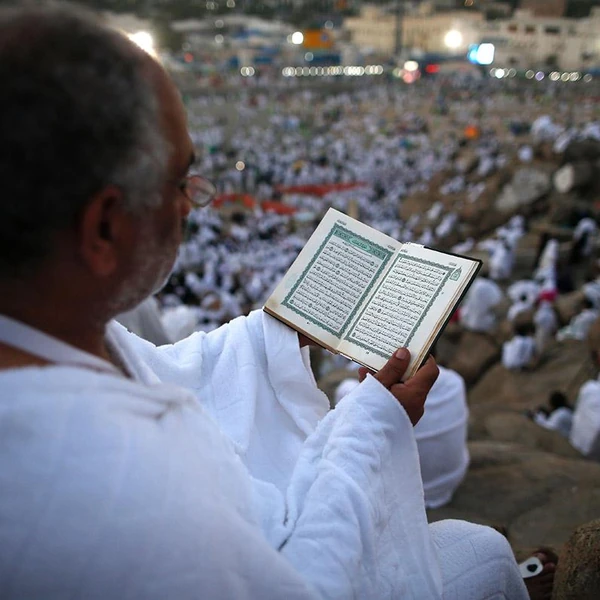
So what does Arafah actually mean in Islam? And why does a single day carry so much weight during Hajj? It’s the ninth day of Dhul Hijjah, and it’s also the plain of Arafat near Makkah, where pilgrims gather for one of the most important parts of Hajj.
Arafah Meaning in Islam and Its Importance
What Does Arafah Mean in Islam?
Arafah means two things. It’s the place where pilgrims stand during Hajj, and it’s the day that standing happens.
This day itself falls on the 9th of Dhul Hijjah, which comes immediately before Eid Al Adha. The pilgrims spend the day in Mount Arafat doing dua and seeking the needs from Allah.
The Qur’an names Arafat directly:
“But when you depart from ‘Arafat, remember Allah at al-Mash’ar al-Haram.”
That’s Surah Al-Baqarah 2:198. The very next verse tells pilgrims to depart with everyone else and ask Allah for forgiveness (Qur’an 2:199).
You’ve probably come across a couple of stories about the name. One says Adam and Hawwa recognized each other there. Another says Jibril kept asking Ibrahim, “Do you know?” They get repeated a lot. But neither one is established through the authenticated hadith collections used here, so I’d leave them out when explaining where the name comes from.
Arafah, Arafat, and the Day of Arafah: Are They the Same?
Close, but not identical.
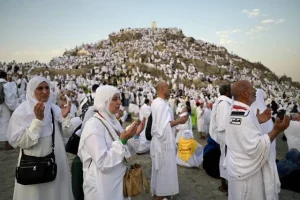
Arafat is the area outside Makkah where the main Hajj standing happens. The Day of Arafah is the ninth of Dhul Hijjah. And in English, people often say “Arafah” for both.
This is why you will have one individual saying “the pilgrims are in Arafat” while another says “I am fasting on Arafah.” This is the same thing, but from a different perspective. One is referring to the place while the other is referring to the day.
This is seen in Surah Al Baqarah, verse 2:198 in the context of pilgrim movement during the Hajj.
When Is the Day of Arafah?
On 9 Dhul Hijjah, the day before Eid al-Adha.
For pilgrims, it’s the main day of Hajj. They head to Arafat, stay for the prescribed standing, then move on toward Muzdalifah. For everyone else, it’s mostly known as a day for voluntary fasting.
These two events are not the same, and they should not be treated as such. One is the experience of standing at Arafat. The other is spending the day at your house, place of work, or local mosque. However, both can use the day to get closer to Allah, but in accordance with what is taught by the authentic sources.
Why Is Arafah So Important During Hajj?
The shortest answer comes from the Prophet ﷺ himself.
In Jami’ at-Tirmidhi 889, he said:
“Hajj is Arafah.”
That narration is graded sahih. People came to him while he was at Arafat and asked about Hajj, and that was his answer. Four words, and they tell you where the whole pilgrimage rests.
Arafat isn’t a stop you can skip. If you miss the standing, you can’t make up for it by doing another ritual instead. The authenticated narration ties the validity of Hajj itself to reaching Arafat within its prescribed time. That’s why the day sits at the center of every conversation about Hajj.
A well-structured way of reading the Quran through a program like that offered by Iqra Quran reading program can help you in understanding the verses related to Hajj and worship.
What Happens at Arafat During Hajj?
On the ninth of Dhul Hijjah, pilgrims gather at Arafat.
The standing is called wuquf. It means staying at Arafat for the prescribed period. You can see how much it matters in Jami’ at-Tirmidhi 889, where the Prophet ﷺ said, “Hajj is Arafah.”
What comes after is in the Qur’an too. Surah Al-Baqarah 2:198 tells pilgrims who’ve left Arafat to remember Allah at al-Mash’ar al-Haram. Verse 2:199 then tells them to depart with the people and seek His forgiveness.
So the trip from Arafat to Muzdalifah isn’t just a change of scenery. It’s one step in a sequence of worship the Qur’an lays out.
Arafah and Seeking Allah’s Forgiveness
If one theme runs through this day, it’s forgiveness.
Surah Al-Baqarah 2:199 tells the pilgrims:
“Then depart from the place from where all the people depart and ask forgiveness of Allah.”
The verse ends by reminding us that Allah is Forgiving and Merciful.
And then there’s Sahih Muslim 1348, which just leaves one gobsmacked. Aishah رضي الله عنها relates from the Prophet ﷺ that there is no day wherein Allah releases more servants from the fire than the day of Arafat. And in addition, the narration tells us that Allah draws near to the pilgrims and speaks to the angels about them.
It’s no surprise Muslims connect this day so strongly with repentance, hope, and asking for forgiveness.
The Day of Arafah and Freedom From the Fire
Read that hadith in Sahih Muslim 1348 again, slowly.
According to Aishah رضي الله عنها, the Prophet ﷺ taught that Allah frees more people from the Fire on this day than on any other.
Observe what it fails to do. It does not ask for us to invent new rites and new incantations. It simply provides a Muslim the legitimate justification of going to Arafah with true remorse, with genuine faith in God’s mercy and with a memory of God. Make your own dua and remember that this day is unique.
We don’t need dramatic stories or shaky claims to make Arafah feel important. The authentic narration already does the job.
Why Do Muslims Fast on the Day of Arafah?
If you’re not performing Hajj, fasting is the clearest Sunnah tied to this day.
In Sahih Muslim 1162, the Prophet ﷺ was asked about fasting on the Day of Arafah. He said he hoped from Allah that it would expiate the sins of the year before it and the year after it.
If you’re able to fast, that’s a big reason to do it. And it’s not a custom that grew over the centuries. The virtue comes straight from an authenticated prophetic narration, which gives the practice solid ground.
If you’re learning Islam as an adult and want more structure around worship and Quran study, Iqra’s program for adult learners gives you a dedicated path.
What Does It Mean That Fasting Arafah Expiates Two Years?
Sahih Muslim 1162 says fasting on the Day of Arafah expiates the year before it and the year after it.
Stay close to that wording and don’t stretch it. It’s not a guarantee that someone can keep sinning on purpose and carry on as normal. The hadith encourages worship and points to Allah’s forgiveness. It doesn’t hand anyone permission to get careless about repentance.
So you fast with humility. You do it because the Prophet ﷺ encouraged it, you hope for the reward Allah promised, and you keep repenting for what you’ve done wrong.
Treating it like a spiritual calculation, where every future mistake is automatically erased, gets it backwards.
Should Pilgrims Fast on the Day of Arafah?
The famous virtue of fasting on Arafah is mainly for Muslims who aren’t standing at Arafat.
Pilgrims have a long, demanding day of worship ahead of them. What the Prophet ﷺ practiced during Hajj is one thing, and the general recommendation for non-pilgrims is another. Mixing the two is an easy mistake to make.
So if you’re reading about the Arafah meaning in Islam because you’re preparing for Hajj, don’t assume every tip written for Muslims at home applies to you in exactly the same way. Learn the specific Hajj rulings carefully from qualified teachers. Scattered advice you found online isn’t a substitute.
Also read about: what is Ashura Day in Islam
Is Arafah Mentioned in the Quran?
Yes.
Arafat is named directly in Surah Al-Baqarah 2:198:
“But when you depart from ‘Arafat, remember Allah at al-Mash’ar al-Haram.”
And the next verse says:
“Then depart from the place from where all the people depart and ask forgiveness of Allah.”
Those are Surah Al-Baqarah 2:198 to 199.
Aishah رضي الله عنها also explained what was behind the command in verse 199. In Sahih al-Bukhari 4520, she reported that Quraysh used to stay at Muzdalifah while the other Arabs went to Arafat. Islam told the Prophet ﷺ to go to Arafat with the people and depart from there.
That gives the verses a very concrete link to how Hajj was actually practiced.
Is Mount Arafat the Same as the Plain of Arafat?
You’ll often see “Mount Arafat” in English travel guides and popular Islamic writing.
But when it comes to mentioning what Hajj demands, it actually refers to the area of Arafat and not climbing or getting to a certain mountain at all. And it creates an image that makes people think that Hajj revolves around standing on a mountain peak.
The authenticated statement in Jami’ at-Tirmidhi 889 is wider than that: “Hajj is Arafah.”
So think of Arafat as the prescribed Hajj area. Don’t shrink the whole ritual down to a photo op at one hill.
What Should Muslims Do on the Day of Arafah?
The authentic sources give us a few clear themes.
For pilgrims, it’s all about Arafat itself. The Prophet ﷺ said, “Hajj is Arafah” (Jami’ at-Tirmidhi 889). For Muslims who aren’t on Hajj, fasting has an explicit virtue in Sahih Muslim 1162. And for everyone, the day is tied to forgiveness, since Sahih Muslim 1348 describes Allah freeing servants from the Fire on Arafah.
So a simple Arafah day might look like this:
fasting, if the Sunnah recommendation applies to you;
sincere repentance;
remembering Allah;
reading and reflecting on the Qur’an;
making your own dua.
That’s really it. No need to overcomplicate it.
Making Dua on Arafah
This is a day when people naturally turn to Allah with their needs, their regrets, their hopes, and their fears.
For pilgrims, the standing at Arafat is itself a long stretch set aside for worship. For the rest of us, the virtues of the day are reason enough to spend more time in sincere dua, instead of letting the ninth of Dhul Hijjah slide by like any other Tuesday or Thursday. Sahih Muslim 1348 describes Allah’s special mercy toward His servants on Arafah, including freeing people from the Fire. That alone is plenty of reason to ask for forgiveness and mercy.
You don’t need a fancy script. Ask Allah honestly for what matters to you: forgiveness, guidance, steadfastness, your family, your wellbeing, a better relationship with Him.
Reading Quran on the Day of Arafah
Reading the Qur’an is good any day of the year, so Arafah is a natural time to spend a bit more with it.
If Arabic pronunciation is hard for you, or you feel shaky when you recite, don’t let that turn the day into a source of stress. Use whatever time you have. Read what you can. Keep learning at your own pace.
If pronunciation is what you’re working on, Iqra’s Tajweed course gives you real instruction, so you’re not guessing from transliteration.
Arafah can give you a push. But steady Quran learning happens over lots of ordinary days, too.
Repentance on Arafah
Arafah and repentance just go together.
In Surah Al-Baqarah 2:199, the Qur’an tells pilgrims to seek Allah’s forgiveness after Arafat. Then Sahih Muslim 1348 describes the exceptional mercy of the day, with Allah freeing servants from the Fire.
Repentance doesn’t need elaborate wording. You can:
recognize what you’ve done wrong;
stop doing it;
ask Allah sincerely for forgiveness;
commit to not going back to it on purpose.
And if you’ve harmed someone else’s rights, repentance may also mean putting those rights right.
Here’s the main thing. Don’t spend Arafah collecting lists of recommended phrases while dodging the personal conversation with Allah that you actually need to have.
Arafah for Muslims Who Aren’t Performing Hajj
You don’t have to be standing in Saudi Arabia to take the Day of Arafah seriously.
The Hajj ritual belongs to the pilgrims at Arafat. But the authentic Sunnah gives everyone else their own way in, through fasting. Sahih Muslim 1162 records the Prophet’s ﷺ words about the expiation tied to fasting on Arafah.
So if you’re at home, you can keep the day simple:
fast if you’re able;
keep up your obligatory prayers;
set aside time for dua;
repent sincerely;
remember Allah;
read some Qur’an.
You don’t have to copy everything the pilgrims are physically doing. Your worship can fit your own situation and still stay rooted in the verified Sunnah.
How Arafah Teaches Muslims About Hajj
If you’ve never performed Hajj, Arafah shows you what the pilgrimage is really built around.
Most people picture Hajj through its famous images: the Ka’bah, the white ihram clothing, the crowds, the stoning of the pillars. Then the Prophet ﷺ says something in Jami’ at-Tirmidhi 889 that moves the focus:
“Hajj is Arafah.”
That one sentence tells a learner the standing at Arafat isn’t a side detail. It’s one of the defining moments of Hajj.
All of the above are easy to take in if you have someone to help you out anytime there is confusion regarding the meanings of some words. Instead of studying in groups, try out Iqra’s tutors individually.
Frequently Asked Questions
What is the simple meaning of Arafah in Islam?
It’s the ninth day of Dhul Hijjah, and also the area of Arafat where pilgrims perform the essential Hajj standing. The Qur’an names Arafat in Surah Al-Baqarah 2:198.
What day is Arafah?
The 9th of Dhul Hijjah, one day before Eid al-Adha.
Why is the Day of Arafah important?
The Prophet ﷺ said, “Hajj is Arafah” (Jami’ at-Tirmidhi 889). The standing at Arafat is at the heart of Hajj.
Is Arafah mentioned in the Quran?
Yes. Surah Al-Baqarah 2:198 names Arafat, and verse 199 gives pilgrims more instructions.
What happens on Arafah during Hajj?
Pilgrims perform the standing at Arafat, an essential part of Hajj, then head toward Muzdalifah. Jami’ at-Tirmidhi 889 shows how central Arafah is.
Should Muslims fast on the Day of Arafah?
If you’re not performing Hajj, yes, it’s strongly encouraged. Sahih Muslim 1162 says it expiates the year before and the year after.
What is special about Allah’s forgiveness on Arafah?
Sahih Muslim 1348 reports that Allah frees more servants from the Fire on the Day of Arafah than on any other day.
Was Surah Al-Ma’idah 5:3 revealed on Arafah?
According to Sahih al-Bukhari 45, Umar رضي الله عنه said the verse about the perfection of the religion came down while the Prophet ﷺ was at Arafat on a Friday.
Is climbing Mount Arafat required for Hajj?
No. The authenticated texts make the standing at Arafat essential. They don’t make climbing one hill a requirement.
What can I do on Arafah if I’m not at Hajj?
Fast if you can, repent sincerely, make dua, remember Allah, keep up your prayers, and spend time with the Qur’an. The fasting virtue is in Sahih Muslim 1162.
Also read about: how many verses in the Quran
Conclusion
The Arafah meaning in Islam goes well beyond the name of a place near Makkah. It’s the ninth day of Dhul Hijjah, the day of the essential Hajj standing, a day tied to remarkable forgiveness, and a day Muslims outside Hajj are encouraged to fast.