


Okay so real talk — when I first heard the term “Meem Saakin,” I genuinely thought it was going to be one of those things I’d never fully understand. Like one of those Tajweed topics that sounds simple on the surface but then turns into this whole complicated thing with exceptions and sub-rules and you end up more confused than when you started.
But it’s not like that. Not even close.
And I think the reason so many people struggle with it isn’t because it’s hard — it’s because most explanations make it sound harder than it is. So let me just… talk to you about it. No textbook language. No stiff formatting. Just the stuff you actually need to know.
Start Here: What Is Meem Saakin, Really?
You know that little mark that looks like a tiny circle sitting on top of a letter? That’s called a sukoon. And what it basically means is — this letter has no vowel. It’s just sitting there, quiet, waiting for the next letter to arrive before anything interesting happens.
When that happens to the letter Meem, we call it Meem Saakin.
That’s genuinely it. You’ve already understood the hardest part.
Now here’s where it gets interesting. That quiet little Meem? How you pronounce it completely changes depending on what letter shows up right after it. Like, the Meem itself doesn’t change — but your mouth does. And that’s what the rules are all about.
How Many Rules?
Please Tell Me It’s Not a Lot.
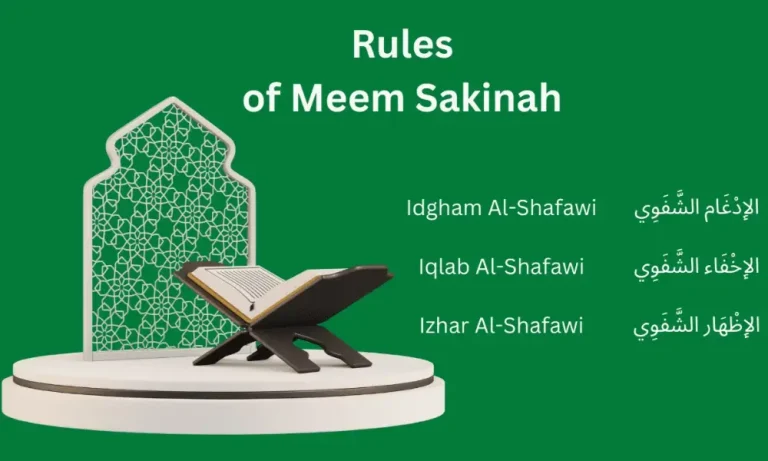
Three.
Breathe. It’s just three.
I remember when I first found that out I was almost annoyed — like, why did it feel so complicated before if there are only three rules? But that’s Tajweed honestly. A lot of it sounds intimidating until someone just sits you down and explains it plainly.
So here they are. All three. And I’m going to explain them really easy.
The First Rule — Ikhfa Shafawi
What triggers it: The letter Baa (ب) comes after your Meem Saakin.
Okay so imagine you’re about to say the Meem — but instead of actually saying it, you kind of… hold it back. Your lips come together like they’re going to make the Meem sound, but then you let out this quiet nasal hum instead. That hum is the ghunnah. Hold it for about two counts and then slide into the Baa.
It’s almost like whispering the Meem rather than saying it out loud.
The first time you hear a good reciter do this it kind of blows your mind because it sounds so smooth. Like there’s no break, no awkward pause — just this beautiful flowing sound that you almost don’t notice unless you’re listening for it.
The Second Rule — Idgham Shafawi
What triggers it: Another Meem (م) comes right after your Meem Saakin.
So now you’ve got two Meems back to back. And what you do NOT do is say them separately. You don’t go “meem… meem.” That sounds wrong and choppy and every experienced reciter will wince.
What you do instead is let them blend. The first Meem just melts into the second one, and you hold the whole merged sound with a strong nasal hum for two counts. It’s one long, smooth Meem — not two short ones.
Honestly once you feel this one in your mouth it feels kind of natural. Two Meems just want to be together. Let them.
The Third Rule — Izhar Shafawi
What triggers it: Literally any other letter that isn’t Meem or Baa.
This one is beautifully simple. Just say the Meem. Clearly. No humming, no blending, no tricks. Clean lips, clear sound, move on with your life.
I know that sounds almost too easy — and weirdly, this is where some people mess up. They’ve been practicing so much Ikhfa and Idgham that their mouth just automatically adds a nasal hum to every Meem out of habit. Izhar is your reminder that sometimes the answer really is just “say it normally.”
Why Is This Still Hard for People Though?
Good question. Because knowing the rules and actually using them while you’re reciting are two completely different things.
Think about it — when you’re reading Quran, your brain is doing so much at once. You’re recognizing letters, tracking vowels, remembering words, trying to maintain a flow. Adding “okay but which Meem Saakin rule applies here” on top of all that is genuinely a lot to juggle, especially when you’re still building the habit.
The Most Common Meem Saakin Errors learners Make During Recitation
So here’s what usually goes wrong:
People rush. This is honestly the root of most Tajweed problems. When you’re going fast, your brain skips steps. You see the Meem, you move on, you never even register the sukoon was there. Slow down. Seriously, almost embarrassingly slow at first.
The ghunnah gets messy. Either people overdo it — turning every nasal sound into this dramatic hum that goes on too long — or they barely do it at all and then wonder why their Ikhfa sounds wrong. Two counts. Not one, not five. Two.
Ikhfa and Idgham blur together. Since both involve a nasal sound, beginners often can’t feel the difference between them yet. And that’s okay — it comes with time and listening. But consciously thinking about what letter follows will help you keep them straight.
Izhar gets nasalized by accident. Pure habit. Your mouth is so used to humming that it does it even when it shouldn’t. Start noticing this.
Not enough listening. This one is huge and I don’t think people talk about it enough. You can read every explanation ever written about Meem Saakin and still not really know what it’s supposed to sound like until your ears have heard it done correctly over and over again.
Also read about: how to say god bless you in Arabic
How to Apply the Rules of Meem Sakinah in Recitation
What Actually Moved the Needle for Me
I’m not going to give you a generic list of tips. Here’s what genuinely helped:
I stopped trying to read and just listened for a while. I picked a surah I knew well and just followed along with a reciter I loved — not reading myself, just listening and letting my ear absorb everything. After a few days of that, something clicked. I could suddenly hear the rules happening in real time.
I recorded myself and it was humbling. The first time I played back my own recitation I cringed. But I also heard exactly what I was doing wrong in a way I never would have caught mid-recitation. Do this. It’s uncomfortable and worth it.
I found a teacher. Even just a few sessions. There is no substitute for someone qualified listening to your actual voice and pointing to the exact moment you made a mistake. Books and videos are great but they can’t hear you.
I used a color-coded Quran. Game changer. When the rules are literally highlighted on the page, your eyes start recognizing patterns before your brain even has to work hard. You see the color, you know the rule, you apply it. It becomes almost automatic.
I stopped trying to be perfect immediately. This sounds obvious but it’s really not. A lot of learners get frustrated when they don’t sound good right away and then they lose motivation. Tajweed is a long road. Small consistent improvement is the whole game.
Also read about: all prepositions in Arabic
The Simplest Practice Routine I Can Give You
Fifteen minutes a day of this will genuinely change your recitation over time:
Pick something short — even just five or six ayaat. Read through them once just to get familiar. Then go back to the beginning and read again, this time stopping at every single Meem with a sukoon. Look at the next letter. Say out loud which rule it is. Then recite that word or phrase correctly.
Do the whole passage slowly like this. Then read it one more time at a slightly more natural pace — still careful, but not stopping every second.
Record it. Listen back. Notice two or three specific things you want to fix. Do it again tomorrow.
That’s it. That’s the whole method. Simple and it works.
Also read about: how do you say in Arabic i love you
Okay So to Wrap This Up
Meem Saakin has three rules and only three rules:
If Baa comes after → Ikhfa Shafawi. Soft nasal hum, don’t fully pronounce the Meem, glide into the Baa.
If another Meem comes after → Idgham Shafawi. Blend them together, hold the nasal sound for two counts.
If anything else comes after → Izhar Shafawi. Just say the Meem clearly. That’s all.
The rules are genuinely not the hard part. The hard part is building the reflex to apply them without thinking, mid-recitation, while also managing everything else your brain is doing. That reflex comes from listening, practicing slowly, getting feedback, and showing up consistently.
You’ll get there. Anyone who puts in honest effort gets there eventually. Just don’t give up when it feels clunky at first — clunky is how everything sounds before it becomes beautiful.
Keep going.
Also read about: how many words in Arabic language
Quick FAQs
So there are really only three rules?
Yes. Ikhfa Shafawi, Idgham Shafawi, Izhar Shafawi. Three situations, three responses.
How long exactly is the ghunnah supposed to last?
Two counts. Think of tapping your finger twice at a steady pace — that’s your timing.
What about Noon Saakin — is that the same?
Similar concept but Noon Saakin has four rules: Izhar, Idgham, Iqlab, and Ikhfa. Worth learning after you’ve got Meem Saakin down.
What is ghunnah again in simple terms?
It’s that humming nasal sound — the resonance you feel in your nose, not your mouth. Close your mouth, hum softly, and you’ll feel it. That’s ghunnah.