


Let me be honest with you — when I first started learning Arabic, prepositions nearly broke me.
This isn’t because they are incredibly difficult to learn; rather, it’s because no one ever took the time to explain them to me in a practical way. Everything that I have read went too far into linguistic terminology or simply provided a vocabulary list without any practical application.
So, I will attempt to describe these prepositions from the perspective that would have helped me understand better when I was learning Arabic.
What Arabic prepositions are.
Even if you have never studied linguistics before, you definitely know what prepositions are. You can probably think of examples such as “in,” “on,” “from,” “to,” and “with.” Prepositions give us information about location, direction, or relation between nouns.
The concept of prepositions in Arabic works in precisely the same way. They are known as حروف الجر (ḥurūf al-jarr). Some common examples include:
في (in)
على (on)
من (from)
إلى (to)
The task appears straightforward yet the actual execution requires different skills than those used in English. The Arabic language requires you to change your pronunciation when you use a preposition with its corresponding following word. The noun following a preposition shift into something called the genitive case (مجرور), which usually means it gets a kasra — that little “i” sound — added to its ending. The Arabic word في البيت transforms into في البيتِ. The change is minor yet it holds significant grammatical value.
The initial experience seems strange to people who use English because English prepositions lack this particular function. Yet the sound becomes correct after your brain adapts to it.
Why you actually need to care about this
Your understanding needs to reach this point because you require this information for your job. The best way to understand this concept requires you to delete every preposition from an English text and observe the result. “I went school. The book sitting desk. This gift you.” The system breaks down completely at that moment.
Arabic functions similarly because its prepositions establish stronger connections between words than English does through its sentence structure. Arabic uses prepositions and case endings to express meaning which English conveys through its sentence structure.
You should start understanding sentences that appear in this form.
في البيت — in the house
إلى المدرسة — to the school
من الصباح — since morning
بسبب المطر — because of the rain
Those prepositions aren’t decoration. They’re load-bearing parts of the sentence.
The full list — don’t memorize it all at once
Here are the Arabic prepositions worth knowing:
من — from
إلى — to
عن — about / from
على — on / upon
في — in / inside
بـ — with / by
كـ — like / as
لـ — for / to
حتى — until
منذ — since
ربّ — perhaps / often (you’ll mainly see this in classical texts)
خلا — except
عدا — except
حاشا — except
حول — around
تحت — under
فوق — above
بين — between
أمام — in front of
خلف — behind
Seriously though — don’t try to memorize all of these in one sitting. That’s a great way to burn yourself out and retain nothing. The first ten on this list are the ones that show up constantly in everyday Arabic. Start there. The others will come naturally as you read and listen more.
Also read about: how many rules of meem saakin are there
How prepositions actually behave in sentences
Let’s get a little more practical. Here’s what prepositions actually do when they show up in Arabic:
They connect verbs to destinations:
ذهبتُ إلى المدرسةِ — I went to school
They describe where things are:
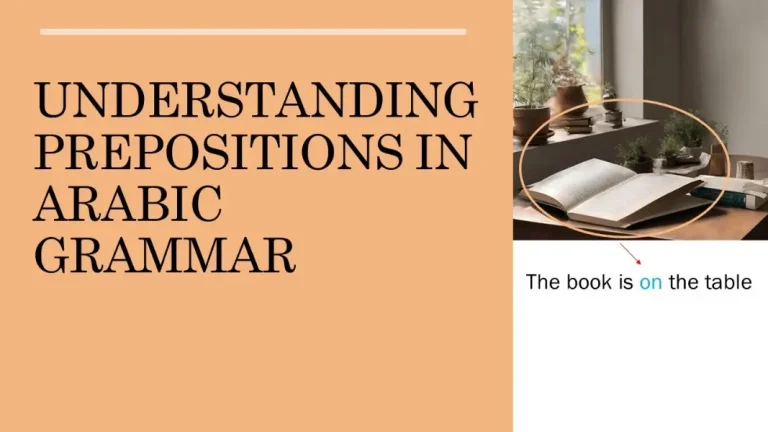
الكتاب على المكتب — The book is on the desk
They fuse with pronouns:
له — for him
بها — with her
That last point is something that surprises a lot of learners. In Arabic, prepositions don’t just sit next to pronouns — they actually merge with them and become a single word. Once you know what to look for, you start spotting these everywhere.
Also read about: how to say god bless you in Arabic
The translation trap — and how to avoid it
Okay, this is really important and I want to spend a moment on it.
A lot of learners — especially those who speak English — try to find the Arabic “equivalent” of each English preposition and just swap them in. This does not work. Arabic and English pair prepositions with situations very differently, and if you rely on direct translation you will get things wrong pretty regularly.
Take بـ for example. Depending on context it can mean “with,” “by,” or “using.” And في usually means “in,” but sometimes it functions more like “at” or “during” from an English perspective.
Look at these sentences:
في المسجد — in the mosque
إلى السوق — to the market
هذا لك — this is for you
كتبتُ بالقلم — I wrote with a pen
The only real way to get a feel for which preposition belongs where is to spend time with actual Arabic — reading it, listening to it, watching it being used in context. Rules help, but exposure is what actually makes it click.
Wait, aren’t some of these adverbs?
Good question, and yes — this confuses people all the time.
The words فوق (above) and تحت (below) function as prepositions but they actually function as locative adverbs (ظروف المكان). Prepositions require a following noun which they transform through their use. A locative adverb can stand on its own and doesn’t cause those grammatical changes.
The phrase في البيتِ serves as a preposition that requires البيت to follow it and modifies its ending. The word فوقَ exists as an independent term which means “above” and requires no additional components.
The method to create correct sentences requires your understanding of this tiny difference.
I see these errors on a regular basis which I personally committed in the past.
People everywhere make these mistakes. Foreknowledge of these mistakes will alleviate your upcoming challenges.
Also read about: how do you say in Arabic i love you
Mistakes I see constantly — and that I made myself
The most common error that people make involves Direct English translation. Arabic prepositions function differently from English prepositions.
People frequently confuse these two words. The word في means “in” but the word على means “on” although specific phrases create overlapping boundaries. The skill develops through experience.
The genitive case ending needs to be remembered. After a preposition, the noun needs to change. Beginners encounter difficulties with this because they must handle multiple tasks simultaneously. Just try to stay aware of it.
Learners base their Arabic language skills on the preposition في because it functions as their most common preposition. Students should make an effort to select their preposition usage from different options.
Students need to stop learning prepositions as isolated words. They should study prepositions within their complete sentence usage. Your Arabic content selection should focus on materials that you find enjoyable. You should listen to a podcast, watch a show, or read a book to observe how prepositions function in everyday language. Your method will achieve superior results compared to any flashcard deck.
If you only learn 10, make it these
في — in
على — on
من — from
إلى — to
عن — about
بـ — with
لـ — for
كـ — like
حتى — until
منذ — since
The ten words appear in almost all Arabic spoken and written forms. If you can use these words with full confidence and accurate execution you will have attained most of your daily language needs. The complete set of knowledge expands from that point onward.
Also read about: how many words in Arabic language
Honestly? It’s not as hard as it seems
People consider prepositions to be a boring grammar subject but the topic becomes difficult to understand at its technical level. Most people need only one page of content for their daily work and they can achieve complete mastery through regular practice.
Take your time. You must avoid attempting to remember all information simultaneously. Your progress will develop gradually through your continuous reading and listening practice. The system operates in that particular manner.
FAQs
How many prepositions are there in Arabic?
Arabic has about 20 prepositions which different sources define based on their inclusion of classical forms.
Which ones should I learn first?
Begin your studies with the Arabic words من، إلى، عن، على، في، بـ، لـ، كـ، حتى، منذ. The ten words will enable you to travel a long distance.
What does حرف الجر actually mean?
The term literally describes “a letter of dragging” because it pulls a noun into the genitive case. The Arabic language uses this term to describe prepositions.
How do you say “4th” in Arabic?
الرابع (al-rābiʿ).