


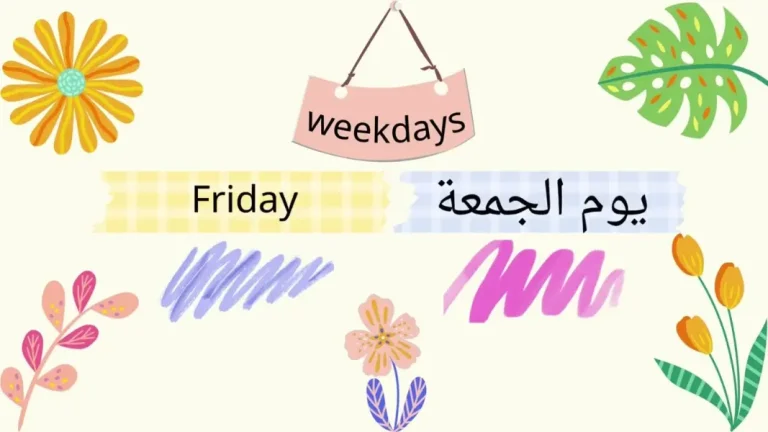
Nobody tells you this when you start learning Arabic, so I will.
The days of the week aren’t random. They’re not named after gods or planets or whatever ancient civilization happened to be in charge when someone decided to label Tuesday. Arabic counted its days. Sunday is the first. Monday is the second. Tuesday is the third. It just keeps going like that until Thursday, which is the fifth.
That’s five out of seven days handled by basic counting.
Once that clicks, the whole thing gets way less intimidating. So lets start there , and work through everything else you need to know about the weekdays name in Arabic, from pronunciation to meaning too— and why Friday is in a category entirely its own.
What Are the Weekdays Name in Arabic?
Arabic has over 400 million native speakers in more than 20 countries. It is one of the oldest continuously spoken languages on earth. And unlike English — where Tuesday is named after a Norse war god and Wednesday after Woden and none of it helps you remember anything — Arabic day names are built on logic you can actually use.
Most of them are ordinal numbers, ya know like the first, the second, the third , all the way through the fifth. That’s already Sunday through Thursday covered. Friday is different though, because it’s named after a gathering and the weekly congregational prayer kind of pulls communities together , so the name fits that. Saturday meanwhile, shares its root with the Hebrew Shabbat. Arabic and Hebrew are both Semitic languages, with thousands of years of shared story, and you can still see that showing up right there in the day’s name.
A few things to know before we go further:
The Arabic week starts on Sunday. Not Monday. Friday is the most sacred day of the week in Islam, that part really stands out. The word for “day” — يوم (Yawm) — comes before every day name, like how in English you say “Monday” but Arabic says something closer to “Day-of-the-Second.” Also Arabic reads right to left, so a printed Arabic calendar runs the opposite way from what you’re used to.
Weekdays Name in Arabic and English
Here’s the full list:
الأحد (al-Ahad) — from the root for “one”
الاثنين (al-Ithnayn) — from the root for “two”
الثلاثاء (al-Thulatha’) — from the root for “three”
الأربعاء (al-Arba’a’) — from the root for “four”
الخميس (al-Khamis) — from the root for “five”
Friday’s name, Jumu’ah, comes from the root ج-م-ع — gathering, assembly, bringing people together. Saturday, Sabt, shares its etymology with the Hebrew Shabbat. These languages have been neighbors for millennia. Some of that history is just baked in. if you seek to master Arabic, Arabic Reading Course at Iqra offers a structured path from complete beginner to confident reader.
How to Pronounce Weekdays Name in Arabic
I want to say something about pronunciation before you read this section: don’t let it stop you.
Most beginners spend so long trying to get the sounds exactly right that they never actually start using the words. Your pronunciation will be imperfect for a while. That’s normal. That’s how language learning works. Say the words badly, get corrected, say them less badly. That’s the whole process.
Here’s each day broken down:
يوم (Yawm) — “yowm.” Rhymes with “home.” Says “day.” You’ll use this constantly.
الأحد (al-Ahad) — “Al-ah-HAD.” Three syllables. Stress the last one hard.
الاثنين (al-Ithnayn) — “Al-ith-NAYN.” The “th” is soft — like in “the,” not like in “think.” That difference matters more than you’d expect.
الثلاثاء (al-Thulatha’) — “Al-thu-LA-tha.” The apostrophe at the end is a glottal stop. A small catch in the throat. Think of the pause in the middle of “uh-oh.” That’s it.
الأربعاء (al-Arba’a’) — “Al-ar-BA-ah.” Another glottal stop at the end.
الخميس (al-Khamis) — “Al-kha-MEES.” The “kh” comes from the back of the throat. If you’ve ever heard a Scottish person say “loch,” that sound. Exactly that.
الجمعة (al-Jumu’ah) — “Al-JU-muh.” Stress the first syllable. Honestly one of the easier ones.
السبت (al-Sabt) — “Al-SABT.” You already know this one. It sounds almost exactly like “Sabbath.”
Say all of them out loud right now. Yes, now. Not later. Hearing yourself say a word even once does more than reading it five times.
The Tajweed Course at Iqra goes deep on Arabic articulation — the rules apply well beyond Quranic recitation and will sharpen your everyday pronunciation too.
Meaning Behind the Weekdays Name in Arabic
Many students focus on transliterating to understand these terms. However, relying on English letters can hold you back from using the actual Arabic script. While starting out, this might help, it’s best to wean yourself off it quickly. Knowing the real meanings of weekday roots actually helps remember them
Ahad (أحد) — “One.” This root appears in one of the most recited lines in all of Islam: “Qul huwa Allahu Ahad” — Say: He is God, the One. Every Sunday, the name of the day quietly echoes that.
Ithnayn (اثنين) — “Two.” Same word used for the number 2 in Modern Standard Arabic. No hidden meaning, just a number.
Thulatha’ (ثلاثاء) — “Three.” Same root as triangle — مثلث (muthallath). Three corners, third day.
Arba’a’ (أربعاء) — “Four.” Same root as square — مربع (murabba’). Four sides, fourth day. Once you know this connection you won’t forget either word.
Khamis (خميس) — “Five.” Also a real person’s name in the Gulf region. If you ever meet someone called Khamis, he’s basically named Thursday.
Jumu’ah (جمعة) — “Gathering.” The root ج-م-ع runs through dozens of Arabic words connected to assembly and collection. The name tells you exactly what the day is for.
Sabt (سبت) — “Rest.” Shared with Hebrew Shabbat. These languages go back far enough together that some words are just the same word.
The Special Significance of Friday in Islam
Friday is kinda the only day that gets its own chapter in the Quran, like it’s singled out in a way. Surah Al-Jumu’ah — Chapter 62 — speaks to believers straight: when the call to Friday prayer comes through, stop what you’re doing and go, not later. Not after you’re finished, Now. The message is really that plain.
Every Friday around midday, Muslim men are required to attend the congregational prayer. It’s the only weekly prayer that can’t just be done at home as a substitute, and the khutbah (sermon) before it has been a space for teaching and shared thinking since the earliest days of Islam. Go into a mosque on a Friday right before Dhuhr and you can feel it fast. more people. more preparing. A slightly different kind of calm during the minutes before it starts.
The Prophet Muhammad ﷺ also described Friday as the best day of the week — it’s the day Adam was created, the day he entered Paradise, and the day the Day of Judgment will arrive. There is also a specific hour on Friday during which du’a is believed to be answered by God. Scholars differ on exactly when it falls — some say the final stretch before Maghrib, others say during the khutbah itself. Most Muslims simply increase their supplication throughout the entire day rather than try to catch one particular window.
That’s why Friday gets its own section in this article. It’s not just a vocabulary word.
Common Sentences Using Weekdays Name in Arabic
Here are the sentences you’ll actually use — not constructed for a textbook, just real conversation:
Asking about the day:
ما هو اليوم؟ — Mā huwa al-yawm? — “What day is it today?”
اليوم يوم الاثنين. — Al-yawmu Yawm al-Ithnayn. — “Today is Monday.”
Planning and scheduling:
سأراك يوم الخميس. — Sa’arāka Yawm al-Khamīs. — “I will see you on Thursday.”
الاجتماع يوم الأربعاء. — Al-ijtimāʿu Yawm al-Arbaʿāʾ. — “The meeting is on Wednesday.”
Talking about weekends:
أحب يوم الجمعة. — Uḥibbu Yawm al-Jumuʿah. — “I love Friday.”
أستريح يوم السبت والأحد. — Astarīḥu Yawm al-Sabt wal-Aḥad. — “I rest on Saturday and Sunday.”
Discussing weekly routines:
أذهب إلى المسجد يوم الجمعة. — Adhabu ilal-masjid Yawm al-Jumuʿah. — “I go to the mosque on Friday.”
أتعلم العربية كل يوم ثلاثاء. — Ataʿallamu al-ʿarabiyyah kull Yawm Thulāthāʾ. — “I learn Arabic every Tuesday.”
Say them out loud. All of them. Right now, not when you have more time. Your brain holds sentences better than individual words, and these are short enough to have memorized before you finish reading this article.
Fun Ways to Remember Weekdays Name in Arabic
1. The Number Trick
This is the most valuable thing in this entire article, and I want to say it one more time clearly: Sunday through Thursday are just the numbers one through five. Learn to count in Arabic — واحد، اثنان، ثلاثة، أربعة، خمسة — and five day names come with it for free. Five days. One trick. Do this first.
2. The Sound Association Method
Ithnayn sounds like “it’s nine” — picture yourself frantically counting to nine on a Monday morning because you’ve hit snooze too many times and you’re late.
Khamis sounds like “khakis” — make Thursday khaki pants day in your head. Ridiculous, but it sticks.
Sabt sounds like “Sabbath.” Because it is.
3. Sticky Note Calendar
Write each day in Arabic on a separate sticky note. Put them in order on your bathroom mirror. Say the Arabic day out loud every morning before you say it in English. Eight seconds a day. Sounds too small to matter. It isn’t.
4. Change Your Phone Calendar to Arabic
Switch your phone’s language to Arabic for one full week. You’ll see the day names dozens of times daily without even trying. Passive exposure like that builds up quietly and faster than active studying sometimes.
5. Sing the Days
Make a tune and sing all seven names in order. It sounds embarrassing. Do it anyway. Music holds sequences in memory differently than plain repetition does, and it works just as well for adults as it does for kids — we’re just less willing to admit it.
6. Journal in Arabic
One sentence a day. Start every entry with the day of the week. “اليوم يوم الثلاثاء.” If that’s all you write, that’s enough. The consistency matters more than the amount.
7. Join a Structured Program
The Adults Arabic Learning Program at Iqra is built specifically for adult learners — not adapted from kids’ materials, not a simplified version of something else. Everyday vocabulary like the days of the week is woven in from the very first lessons, so you’re using real language in real context from day one.
Conclusion
Seven words. That’s where this started.
But every single one of those words has something underneath it — a number root that connects to the rest of Arabic, a strand of shared history with Hebrew, a Quranic chapter named after a single day, a man somewhere in the Gulf whose parents named him Thursday and who has never once thought of it as unusual.
That’s what Arabic is like. There’s almost always more underneath.
Start with these seven. Use them this week. Write your schedule in Arabic, even messily. Say the day out loud every morning, like really out loud. Pretty quickly it stops sounding like foreign vocabulary, and kind of starts to feel like words you already know.
Also, every person reading Arabic fluently right now basically started at the exact same spot you are at… they just did not quit. Or didn’t, you know, stop.
Frequently Asked Questions About Weekdays name in Arabic
How do you say “weekday” in Arabic?
The formal phrase is يوم من أيام الأسبوع (Yawm min ayyām al-usbūʿ) — literally “a day from the days of the week.” But in everyday chat, most people use يوم عمل (Yawm ʿamal), like a working day. And the word for “week” is أسبوع (usbūʿ).
What is midday in Arabic?
Midday is الظهر (al-Ẓuhr), and it’s also the name of the Islamic midday prayer. In casual talk, you’ll hear midpoint-of-the-day, which is منتصف النهار (muntaṣaf al-nahār), like “the middle of the day,” for noon.
Are Arabic Day Names the Same in Every Arab Country?
Yes. Modern Standard Arabic keeps the day names the same everywhere. But dialects can shift pronunciation a bit, Egyptians say el-Gumʿa, and others say al-Jumu’ah. Still, grab any written Arabic newspaper from any Arab country and the day names look exactly the same.