


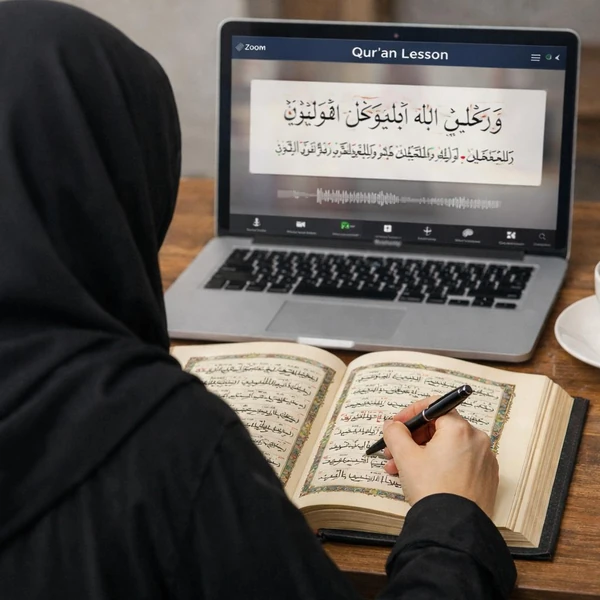
Here’s the thing about learning the Quran properly: wanting to isn’t usually the problem. Finding the time is. Finding a quiet room is. Finding a teacher who doesn’t make you feel rushed is. Online classes fix most of that in one move you learn from your own house, on your own schedule, with someone actually listening to your recitation instead of a video playing at you. This guide covers what to study first, how to actually vet a teacher, and how to build something that survives past the second week, because that’s usually where people fall off.
Why Online Quran Classes for Sisters Make Sense
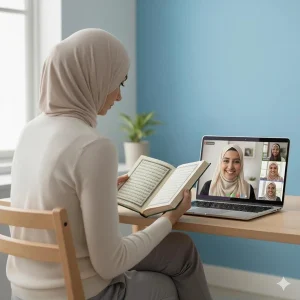
For most women, it was never about interest. It was nap times. School runs. A class at 7pm when the kids need dinner. A mixed room where reciting out loud in front of strangers feels like the last thing you want to do. Take that room out of the equation and a lot of the resistance just disappears.
This isn’t some new accommodation, either. In Sahih al-Bukhari 101, Abu Said al-Khudri reports that a group of women told the Prophet ﷺ, plainly, that the men were taking up all his time. So he gave them a day of their own. That’s over 1,400 years old.
What actually changes when you go online: the lesson happens when it suits you, not the other way around. No commute, no scanning the neighborhood for a class that fits. Your teacher’s full attention is on your recitation, not on managing twenty other kids in a room. And if you didn’t get something, you just ask again nobody’s waiting on you.
What the Quran and Sunnah Say About Learning
The very first revelation was a command to read. “Recite in the name of your Lord who created” (Quran 96:1). Not a greeting, not a warning an instruction to learn. That tells you something about where this sits in the whole picture.
The Prophet ﷺ didn’t leave much room for interpretation on this either. In Sahih al-Bukhari 5027, Uthman reports him saying the best among you are those who learn the Quran and teach it. He said “you,” not “the men” or “the scholars.” Everyone.
And the reward isn’t reserved for people who already recite well. In Jami’ at-Tirmidhi 2910, Ibn Mas’ud reports that every single letter read from the Quran earns a good deed, multiplied ten times and the Prophet ﷺ went out of his way to point out that Alif, Lam, Mim each count on their own, not as one word. So even the slow, halting reading of a beginner is already earning something. That’s worth remembering on the days it feels pointless.
Who Can Join? Every Level Is Welcome
You genuinely don’t need to know a single Arabic letter to start. Classes start wherever you actually are, not wherever you feel you should be. That might look like:
Never having read the Arabic script. Reading fine but nobody’s ever caught your Tajweed mistakes. Being a mother trying to squeeze lessons in around a toddler. Working full time, with only 6am or 9pm free. Coming to Islam recently and starting from nothing. Or just being older and assuming, wrongly, that the window’s closed.
If the fear is “I’ll be too slow,” sit with Sahih al-Bukhari 4937 (also Sahih Muslim 798) for a second. Aisha reports that the person who stumbles through the Quran, who finds it genuinely hard, gets double the reward. Not less. Double. If you want something structured to start with as an adult, Iqra’s adult Quran classes were built with exactly this in mind.
Common Worries Before Starting
Nerves before lesson one are normal. Almost everyone has them. They almost always go away by lesson two.
“I’ll be embarrassed reading aloud.” Every teacher on this platform works with beginners constantly. Nobody’s expecting you to sound polished on day one if you already could, you wouldn’t need the lesson.
“My accent is too strong.” Your accent was never actually the issue. Unclear letters are, and that’s a fixable, teachable thing.
“I’m too busy.” Two lessons a week, twenty minutes a day. Most people have that somewhere.
“I tried this before and quit.” Nine times out of ten that’s the wrong starting level, or a teacher who checked in once and disappeared. Neither of those is a reason it won’t work this time.
“I don’t even know if this is for me.” Fair. Book one trial lesson and find out instead of guessing.
Types of Quran Classes You Can Choose From
Most sisters aren’t doing just one of these over time they usually end up mixing two or three.
Quran reading is the letters, the sounds, and stitching them into words. If you’re starting at zero, this is it, and our Quran reading program is built for exactly that starting point. Tajweed is the rulebook that keeps your recitation accurate rather than approximate. Memorization, or Hifz, is committing passages to memory and then actually keeping them there through review. Tafsir is sitting with what the verses mean, not just how they sound. Arabic is learning the language itself so you’re not reciting words you don’t understand. And Islamic studies covers belief, character, and the daily practice of the religion.
Also read about: how to start prayer in Islam
Which Course Should You Start With?
Be honest about where you are, not where you wish you were.
Can’t read the letters? Start with reading there’s no shortcut around this one. Read okay but your pronunciation feels shaky? Tajweed first. Solid, steady recitation and you want more in your memory? Go to memorization. Want to actually understand what you’re saying? Add tafsir or Arabic next to whichever of these you pick.
None of this is a permanent choice. Plenty of students run Tajweed and tafsir side by side one fixes the tongue, the other does something to the heart that Tajweed alone can’t. Still unsure? Talk to a teacher for ten minutes. They’ll listen to you read a few lines and tell you, honestly, where you actually stand.
How a Typical Lesson Works
Teachers all have their own rhythm, but most sessions move through the same basic stages. You recite what you practiced since last time. The teacher stops you where something’s off and explains why. You get new material a page, a rule, whatever’s next walked through properly. You practice it out loud together until it stops feeling shaky. And you leave with one small thing to work on, not five.
The shape matters more than the clock. When lessons follow the same pattern every time, you stop wondering what’s coming and start noticing what you’re actually improving at. Most sessions land somewhere between thirty minutes and an hour.
Learning Tajweed the Right Way
Allah says to recite the Quran in measured tones (Quran 73:4) tartil. Slow. Clear. Deliberate. Tajweed is just the technical name for how you get there.
You’ll work through makharij where each letter actually originates in your mouth and throat. Sifaat the character of a letter, whether it’s strong or soft, heavy or light. Madd how long you hold a vowel sound. Noon sakinah and tanween, and the way they change shape depending on what follows them. Qalqalah, that small bounce on certain letters that’s easy to miss and easy to overdo.
Here’s the honest truth: almost nobody can hear their own mistakes. That’s not a personal failing, it’s just how it works. A teacher can hear them, though, and that’s the entire reason live correction beats an app every time. Iqra’s Tajweed course puts a real, qualified teacher on the other side of your recitation, correcting it in the moment, not after the fact.
Memorizing the Quran While Running a Busy Home
Allah says He made the Quran easy to remember (Quran 54:17). Easy doesn’t mean instant, and it doesn’t mean effortless it means it’s actually achievable, and women do it every day alongside jobs, toddlers, and everything else.
Keeping it, though, is where people struggle. In Sahih al-Bukhari 5033, Abu Musa reports the Prophet ﷺ comparing the Quran to a hobbled camel it slips away from you faster than you’d think, so you have to keep checking the rope.
A rhythm that actually holds up looks something like this: a small new section, sometimes just a few lines. Yesterday’s lines and last week’s, kept fresh. And a rotating slice of the older material, so nothing gets forgotten just because it’s not new anymore.
Start smaller than feels impressive. Iqra’s memorization program builds the review in from day one, so what you learned in month one is still there in month six.
Adding Meaning: Tafsir and Arabic Alongside Recitation
Reciting well feels good. Knowing what you’re actually saying feels completely different.
You don’t need to wait until your recitation is flawless to start on this. A lot of sisters add meaning in small pieces, early on a short translation of whatever passage they’re working on, a quick question to their teacher about a word or the background of a verse, picking up vocabulary from surahs they already know by heart, or joining a group where people actually discuss what a verse is doing.
Iqra runs guided discussions on meaning and separate courses in Arabic, so this can grow at whatever pace fits. Start with the short surahs you already say in every prayer. Once you know what they mean, salah starts to feel like a conversation instead of a recitation.
Why a Live Teacher Matters
This has never been a solo pursuit. Sahih al-Bukhari 6 records Ibn Abbas saying that Jibril came to review the Quran with the Prophet ﷺ every single night of Ramadan. Even revelation, the most direct transmission imaginable, still came with a teacher attached to it.
An app can play you a recitation. It can’t hear yours. A real teacher catches the mispronounced letter as it happens, not three lessons later. Slows down the moment you’re struggling instead of plowing ahead. Gives you something specific to do before the next session. And notices when you’re losing motivation before you’ve said a word about it.
At Iqra, lessons are one-on-one, built around you specifically not a script that gets read out regardless of who’s on the other end.
How to Choose a Qualified Teacher
Ask questions before you commit. A teacher worth learning from will want you to.
Where did they study, and do they actually hold an Ijazah in recitation, or are they self-taught? Have they worked with adult beginners or non-Arabic speakers before, specifically? Are the lessons live not a recorded video with your name pasted on it? Do you walk away from each session knowing exactly what to practice, or vaguely knowing you “did a lesson”? Can they explain things in a language you’re actually comfortable in? And are they patient when correcting you because you will be corrected constantly, and it should feel like help, not judgment.
Treat the first lesson as a test run, honestly. If something feels off rushed, cold, dismissive believe that feeling and look elsewhere.
One-on-One or Group Classes?
Neither is objectively better. They just solve different problems.
One-on-one gets you full attention and total privacy the right call if you’re shy, starting from nothing, or just short on time. Group classes bring other people into it, and there’s something to be said for hearing another sister stumble through the same rule you’re struggling with. It makes skipping practice harder to justify.
Iqra offers both private lessons plus weekly group halaqas for reflection and connection. A lot of students start private and add a group in once they’ve found their footing.
Privacy, Comfort, and Safety While Learning Online
Being comfortable is what lets you actually focus, so a few things are worth sorting out early. Pick a quiet room where you won’t be interrupted mid-sentence. Agree with your teacher on camera expectations before the first lesson, not during it. Keep every payment and message inside the platform itself. If it’s a teenager taking the lessons, have a parent sit in for the first few. And if anything feels wrong at any point pause. Say something. Trust that instinct.
A platform worth using should be able to explain all of this to you without hesitation, in detail, the moment you ask.
Fitting Quran Study Into a Busy Week
Small and consistent beats big and occasional, every time. Fifteen minutes a day will outperform two hours once a week, and most teachers will tell you the same without being asked.
Attach practice to something you already do right after Fajr, right after Maghrib. Leave your mushaf somewhere you’ll actually see it, not tucked in a drawer. Keep your lesson at the same time each week if you can. And just tell your teacher when Ramadan’s coming, or exams, or travel they’ll adjust with you instead of pretending your life isn’t happening.
On the weeks it feels hard, there’s Sahih Muslim 804. Abu Umamah reports the Prophet ﷺ telling people to recite the Quran, because on the Day of Resurrection it will come forward to intercede for the people who kept it close.
How to Practice Between Lessons
The lesson points you in a direction. What you do in the days after is where the actual change happens.
Work small pieces properly one line recited well beats a whole page recited carelessly. Record yourself and actually listen back against your teacher’s version; it’s uncomfortable the first few times, and useful every time after. Stick with one reciter you trust so your ear gets used to consistent Tajweed instead of five different styles. Write down your questions as they come up instead of trying to remember them at the next lesson. Look back at yesterday’s page before touching today’s. And read out loud your eyes learning it isn’t the same as your tongue learning it.
Ten focused minutes, done daily, beats an hour done once. That’s not a motivational line, it’s just how the skill actually builds.
Setting Up Your Learning Space
Nothing complicated here: a printed mushaf you intend to keep using long-term, headphones with a mic that actually works, a stable connection with your phone as a backup, a notebook for corrections, and enough light that your teacher can see your mushaf if needed.
Test your audio before the lesson starts. There’s nothing more deflating than burning ten minutes of your session on “can you hear me now?”
What Progress Looks Like in the First Three Months
Take this as a rough shape, not a guarantee everyone moves differently.
Month one is mostly your teacher figuring out your habits while you settle into showing up regularly. Month two is where corrections start actually sticking, and reading gets a bit smoother without you consciously trying. Month three is shorter passages coming out with fewer stops and more confidence in your own voice.
If it feels slower than you hoped, don’t measure yourself against anyone else’s timeline. The struggle itself is the thing Sahih al-Bukhari 4937 is talking about it’s not a sign you’re doing it wrong.
Common Mistakes to Avoid
Most people who stall out are doing one of these, not something rare or complicated.
Skipping the basics because they feel too easy those gaps don’t disappear, they just show up later as harder-to-fix habits. Jumping into memorization before pronunciation is solid, which just means memorizing your own mistakes permanently. Only opening the mushaf on lesson days a week is a long time for a skill this new to sit untouched. Letting old material go once it feels “done,” when it actually fades faster than expected. Switching teachers every few weeks, which means restarting the assessment from zero each time. Picking a teacher on price alone cheap lessons that never correct anything cost you more time in the end than they saved you in money. And leaning only on audio, because listening tells you what it should sound like, but nobody’s there to say “that letter, right there, was off.”
Quran Classes for Teenage Girls and Mothers Learning With Their Children
A lot of mothers want to learn at the same time as their kids, and it works as long as each person has their own separate lesson slot. Nobody wants to feel watched while they’re stumbling through a new page.
For younger daughters specifically, Iqra’s Quran classes for kids are worth a look. Teenagers usually respond better to a bit more structure than younger kids need, and having a parent involved for the first few weeks helps them settle without feeling babysat.
Learning side by side ends up giving the whole household something in common. Everyone’s practicing, everyone’s reviewing, and at some point the Quran stops being a separate task and just becomes part of how the day runs.
Conclusion
None of this age, background, how far behind you feel actually rules you out. Online classes put a real, qualified teacher and a schedule that bends around your life within reach, from wherever you’re sitting right now. Start where you honestly are. Pick a teacher who actually listens. Keep the practice small enough that it survives a bad week.
The Prophet ﷺ said the best among us are the ones who learn the Quran and teach it. Your first lesson is just the start of that.
Also read about: how many steps in wudu
Frequently Asked Questions
Do I need to know Arabic before I start?
No. Reading courses begin with the letters themselves, so starting from zero isn’t a problem it’s the expected starting point.
How long does it take to read the Quran fluently?
Depends entirely on your starting point and how often you show up to practice. Ask your teacher for an honest number once they’ve actually heard you a few times.
Can I learn with small children at home?
Yes. Short lessons and flexible timing make this genuinely realistic plenty of students schedule around nap time or the school run.
What if I make mistakes while reciting?
You will, constantly, and so does everyone else. Sahih al-Bukhari 4937 says the person who struggles through it gets double the reward, not a lesser one.
Am I too old to start?
No. Allah made the Quran easy to remember (Quran 54:17), and adults start from scratch every single day.
Should I learn Tajweed or memorize first?
Most teachers say pronunciation comes first, so you’re not locking in mistakes as you memorize. Your teacher can tell you for certain once they’ve heard your recitation.
Can I take classes during Ramadan?
Yes Sahih al-Bukhari 6 even shows the Prophet ﷺ reviewing the Quran with Jibril every night of Ramadan, and a lot of students actually pick up the pace that month.
Do I need a printed mushaf?
It helps a lot. The same page layout every time makes memorization noticeably easier.
Can teenage girls join with a parent’s involvement?
Yes. A parent sitting in on the first few lessons and staying in touch with the teacher is completely normal.
Is online learning as effective as in-person classes?
It can be, provided the lessons are live and the teacher can actually hear and correct you in real time.
What if I miss a lesson?
Tell your teacher as soon as you know. Most will reschedule, and a quick review before the next session keeps you from losing ground.
Can I change my teacher if it isn’t a good fit?
Yes, and you should if it isn’t working. Fit changes how consistently you actually show up, so it’s worth getting right.