


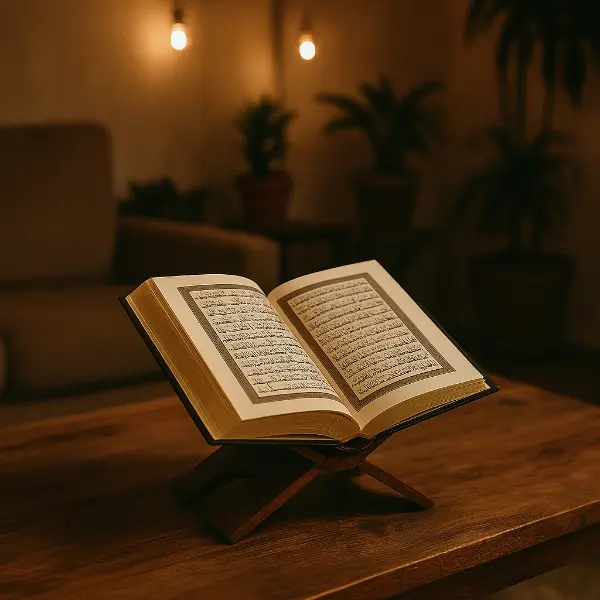
Wanting to memorize a page of Quran fast is a goal many students share, especially when a class deadline or personal target is looming. The good news: speed and accuracy aren’t opposites. With the right method, a full page becomes manageable in under an hour, and sometimes much less.
Why Speed Alone Isn’t Enough in Quran Memorization
Rushing without a system usually backfires — you’ll “finish” a page but lose half of it by the next day. Real speed comes from doing fewer, more focused repetitions correctly, not more repetitions carelessly.
This isn’t just practical advice. The Prophet ﷺ described both fluent reciters and those who struggle as rewarded, saying the one skilled in reciting is with the noble, recording angels, while one who struggles through it earns a double reward (Sahih Muslim, 798a). Whether recitation comes easily or with effort, the goal is the same: get it right, not just get it done.
Preparing Yourself Before You Start
Before opening the Mushaf to memorize, a few minutes of setup saves far more time later.
Making Sincere Intention (Niyyah)
Start by renewing your intention — memorizing for Allah’s sake, not just to finish a page. This keeps you consistent when motivation dips.
Choosing One Mushaf and Sticking to It
- Use the same physical copy or app layout every session
- Your brain memorizes word position on the page, not just the words themselves
- Switching editions resets that visual map and slows you down
Reading the Page Aloud Before Memorizing
Read the full page aloud two or three times before attempting to memorize anything. This “imprinting” step familiarizes your tongue with unfamiliar words so you’re not learning pronunciation and memorization at the same time. Adult learners returning to Quran study after a gap benefit especially from this step — Iqra’s program for adults builds it into every session.
The Core Method to Memorize a Page of Quran Fast
This is the foundation every timed method below builds on.
Breaking the Page into Small Sections
Do not try to memorize 15 lines at one time; break up the material into 3-5 lines per page. It is known that the short-term memory capacity is about 5-7 things at one time.
Repeating Each Section by Sight, Then by Memory
- Recite each chunk 5–10 times while looking at the text
- Recite the same chunk 5–10 times from memory, eyes closed or looking away
- If you hesitate even once, repeat the sight-reading step before moving on
Linking Sections Together (Accumulative Recitation)
Once two chunks are solid individually, recite them together as one unit before adding a third. This “building block” approach — sometimes called accumulative linking — is what prevents you from reaching the bottom of the page having already forgotten the top. Structured, teacher-guided practice of this technique is one of the core skills taught in Iqra’s memorization program.
How to Memorize a Page of Quran in 1 Hour
This pace suits most learners and gives room for real accuracy.
- Minutes 0–10: Listen to the page recited once or twice, then read it aloud yourself
- Minutes 10–40: Memorize in two halves (roughly 7–8 lines each), using the sight-then-memory method above on each chunk
- Minutes 40–50: Connect the two halves — recite the last line of the first half with the first line of the second half repeatedly until it flows
- Minutes 50–60: Test yourself with the Mushaf closed; fix only the specific ayahs where you stumble
How to Memorize a Page of Quran in 30 Minutes
A faster pace for students already comfortable reading fluently.
- 5 Minutes First: Read or hear the page rapidly for spotting hard words
- 20 Minutes Next: Break up into 3 sets of 5 lines each and read each set aloud 3 times, and try to repeat it from memory before proceeding to the next set
- 5 Minutes Last: Combine all 3 sets and recite the entire page from memory
This requires much more focus per minute, thus a quiet environment is all the more important.
Can You Really Memorize a Page in 5 Minutes?
Honestly — not a brand-new page, not for most learners. A genuine 5-minute memorization is realistic mainly for reviewing a page you’ve memorized before and partly forgotten, or for advanced students with years of practice.
What you can do in 5 minutes is build a rough mental map: stare at the page for 60 seconds noting the first and last word of each line, then read it fast three times, then test yourself on the first, middle, and last ayah. That’s a genuine head start, not a full memorization — treat it as such rather than chasing an unrealistic claim.
The Role of Listening to Recitation While Memorizing
Listening before you memorize prevents “false Hifz” — locking in a mispronounced word or an incorrect vowel that becomes hard to unlearn later.
- Play the page from a measured, clear reciter before you begin
- Follow along in your own Mushaf while listening
- Loop any line you’re unsure of a few extra times
A live teacher catches pronunciation slips an app can’t. This is exactly where working with Iqra’s teachers makes a measurable difference in accuracy, not just speed.
Understanding the Meaning to Aid Retention
The Quran isn’t a list of disconnected sentences — it has a narrative logic. When you understand what a verse means, your brain anticipates what naturally comes next, which speeds up recall.
Even a quick glance at a translation before memorizing helps you notice how consecutive ayahs connect — cause and effect, a statement followed by its explanation, a command followed by its reasoning. This doesn’t need to be a full tafsir session; a few minutes of reading the meaning alongside the Arabic is enough to strengthen the memory hook.
Reviewing What You’ve Memorized (Muraja’ah)
New memorization without review disappears quickly. Structure your review the same way you structure new memorization.
- Revise yesterday’s page before starting a new one (Sabaq–Muraja’ah balance)
- Keep a simple log of which pages need extra attention
- Space reviews out: day 1, day 2, day 5, day 10 works well for most learners
Skipping review to memorize “faster” is a false economy — you’ll spend more time re-memorizing forgotten pages than you saved.
Common Mistakes That Slow Down Memorization
- Switching Mushaf editions mid-journey — resets your visual memory
- Memorizing without understanding meaning — makes recall purely mechanical and fragile
- Skipping the sight-reading step — leads to memorizing mispronunciations
- No review schedule — new pages quietly erase older ones
- Comparing your pace to someone else’s — discourages consistency, which matters more than raw speed
Tips for Kids vs. Adults Memorizing Quickly
Children and adults don’t memorize the same way, so the “fast” method should flex slightly.
- Kids often absorb rhythm and repetition naturally — short, playful sessions (15–20 minutes) with a lot of listening work well, and consistency matters more than intensity
- Adults usually benefit more from understanding meaning first, since that logical anchor compensates for a less flexible memory
- Both groups need a teacher who adjusts pace to the individual rather than a fixed timetable
Iqra’s program for kids is built around this shorter, engagement-first structure rather than pushing children through adult-paced sessions.
Getting Guidance From a Qualified Teacher
Self-study can get you far, but a teacher catches errors you can’t hear in your own recitation — and the virtue of that guidance is significant. The Prophet ﷺ said the best among people are those who learn the Quran and teach it (Sahih al-Bukhari, 5027).
A teacher also keeps you accountable to a real review schedule, which is often the piece self-taught students drop first once the initial motivation fades. If speed is genuinely your goal, structured feedback shortens the number of repetitions you need — you’re not guessing whether a chunk is solid, someone is confirming it.
Conclusion
Learning how to memorize a page of Quran fast comes down to a simple formula: chunk the page, repeat with intention, link the pieces together, and review consistently. Speed follows naturally once accuracy is in place — not the other way around.
Frequently Asked Questions
How long should it take to memorize one page?
For most learners, 30–60 minutes for a new page is realistic and sustainable. Faster is possible with experience, but accuracy should never be sacrificed for speed.
Is it better to memorize alone or with a teacher?
Self-study works, but a teacher catches pronunciation errors early and keeps your review schedule consistent — both directly affect how fast memorization actually sticks.
What’s the best time of day to memorize?
Early morning, when the mind is rested and distractions are minimal, tends to work best. Consistency in timing matters more than the specific hour chosen.
Does understanding the meaning really help memorization?
Yes. Knowing what a verse means creates a logical link to the next one, which makes recall far more reliable than memorizing sound alone.
How do I stop forgetting what I’ve memorized?
Daily review (Muraja’ah) of previously memorized pages, on a spaced schedule, is the only reliable fix. New memorization without review fades quickly regardless of how well it was learned initially.