


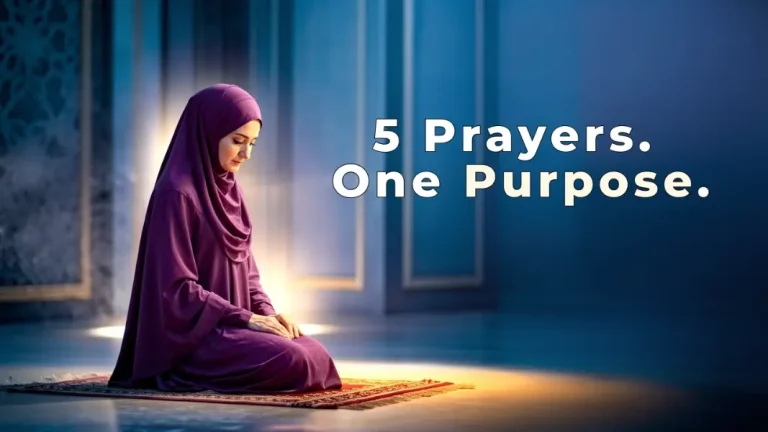
If you’ve ever watched a Muslim friend or colleague step away at set times during the day, you’ve probably wondered about the reasoning behind it. It’s one of the most common questions people ask, whether they’re new to Islam themselves or just curious: how many times do Muslims pray a day, and why does the number matter so much? Let’s walk through it properly.
Why Is Prayer Important in Islam?
Salah (prayer) is one of the five pillars of Islam, and to tell you the truth, it is considered to be the pillar that supports the connection of a believer with his creator, Allah. It’s not an occasional act; rather, it’s an everyday activity that keeps believers in touch with their Lord.
- According to Sunan at-Tirmidhi, it’s the first question that would be raised by God from every individual on the Day of Judgment.
- It sets a practicing Muslim’s daily rhythm apart from someone who isn’t observant
- It became compulsory during the Prophet’s nighttime journey, Isra and Mi’raj, according to both Sahih al-Bukhari and Sahih Muslim
- It makes one thankful and aware of Allah habitually, something which normally could become monotonous.
But if one is attempting to develop such a basis from scratch, Iqra courses for adults could be a good choice to begin with, because they take one through the process of salat step by step.
How Many Times Do Muslims Pray a Day?
The short answer is five. Muslims pray five times a day, and this isn’t up for debate or personal preference; it’s fixed. It’s actually one of the clearest, most visible markers of someone practicing the faith. Once you understand how many times do Muslims pray a day, the rest of Islamic daily life starts to make a lot more sense, because everything else is built around these five points.
The Obligation of Five Daily Prayers
Here’s where it gets interesting. The five prayers weren’t always five. During the Mi’raj, when the Prophet Muhammad (peace be upon him) ascended through the heavens, fifty prayers were originally prescribed. Through a series of exchanges (the Prophet going back and forth on the advice of Musa, peace be upon him) the number was eventually reduced to five, while the reward stayed at fifty. This account appears in Sahih al-Bukhari (Hadith 349) and Sahih Muslim (Hadith 164). It’s a small detail, but it says a lot about how Islam treats worship: demanding, yes, but never beyond what a person can realistically sustain.
The Importance of Consistency in Worship
It is reported from the Prophet Muhammad (peace be upon him) that he said, “The most regular constant deeds even though they may be few.” and this Hadith appears in both Sahih al-Bukhari and Sahih Muslim. This is what being consistent about it all really means. It’s about being there and doing it again and again because, in the end, it will accomplish several things:
- It keeps remembrance of Allah present throughout the day instead of tucked away for Fridays
- It gives people something steady to hold onto during hard stretches of life
- It naturally organizes the day around it, whether people realize it or not
- It creates a sense of accountability, since skipping prayer is taken seriously in Islamic teaching
For anyone who struggles with staying consistent, studying alongside others through the Iqra halaqas tends to help far more than trying to go it alone.
Also read about: how many steps in wudu
What Are the Five Daily Prayers?
Each prayer has its own name, its own number of units (rak’ahs), and its own slot in the day:
- Fajr – at dawn, before the sun rises, made up of 2 rak’ahs
- Dhuhr – shortly after the sun passes its highest point, 4 rak’ahs
- Asr – in the afternoon, 4 rak’ahs
- Maghrib – right after sunset, 3 rak’ahs
- Isha – at night, 4 rak’ahs
Put together, these five prayers frame the entire day, from the quiet hours before sunrise all the way to nightfall.
Also read about: how to start prayer in Islam
When Are the Five Daily Prayers Performed?
Something people often find surprising is that prayer times aren’t fixed to a clock. They’re tied to the sun. That’s why the schedule shifts a little every single day.
Prayer Times Based on the Sun’s Position
Instead of arbitrary hour markers, each prayer is anchored to something observable in the sky:
- Fajr starts at true dawn and runs until just before sunrise
- Dhuhr starts once the sun has passed its peak
- Asr begins once a shadow reaches a certain length
- Maghrib starts the moment the sun sets
- Isha begins once the last trace of twilight disappears
Because these markers move with the seasons, and with where you happen to be standing on the globe, prayer times in Cairo won’t quite match prayer times in Jakarta, and both will shift again as the year rolls on.
How Muslims Track Prayer Times
Nowadays, most people rely on a blend of old and new methods:
- The adhan, broadcast from local mosques
- Prayer time apps that calculate timings based on GPS
- Printed monthly schedules from Islamic centers
- In some places, still, people watching the shadows the old-fashioned way
If you’re curious how the Quran itself frames the concept of prayer and its timing, the Iqra Quran reading course covers that in more depth than a quick article ever could.
Why Do Muslims Pray Five Times a Day?
Five feels like a deliberate middle ground, demanding enough to actually shape a person’s character, but not so demanding that it becomes impossible to keep up. A few reasons this structure exists:
- It keeps a person in regular contact with Allah rather than checking in occasionally
- It breaks the day into natural pauses, which cuts down on getting lost in worldly distractions
- It reflects a kind of mercy, since the fifty prayers were reduced to five while the reward of fifty remained, per the hadith in Sahih al-Bukhari
- It draws people together, since congregational prayer in mosques builds community in a way solitary worship can’t
What Happens During Each Prayer?
The structure of each prayer stays largely the same, even though the number of units changes:
- Setting the intention (niyyah) quietly, in the heart
- Reciting Surah Al-Fatihah, the opening chapter of the Quran
- Reciting another portion of the Quran afterward
- Bowing (ruku), along with specific supplications
- Standing briefly again before going into prostration
- Prostrating (sujood) twice each unit, with its own supplications
- Sitting between prostrations, and again at the end for the tashahhud
- By concluding with the taslim where you turn your head to right and then left.
The importance of getting the recitation correct is something that not everyone realizes. This is precisely why there are so many people who opt for the Iqra Tajweed course.
What If a Muslim Misses a Prayer?
Life happens, and prayers do get missed sometimes. But how it’s handled depends heavily on why it was missed.
- If someone slept through it or genuinely forgot, they should pray it the moment they remember. This comes from a hadith in Sahih Muslim instructing exactly that.
- If a prayer was pushed past its time window without a valid reason, scholars generally treat this as a serious matter requiring real repentance.
- Prophet Muhammad (PBUH) once said that prayer is the separation between belief and disbelief, which is documented in Sahih Muslim.
When people face difficulties getting back on track with their praying routine due to bad times in their lives, the Iqra adult program will be the best way to go about it.
Benefits of Praying Five Times a Day
Set aside the religious obligation for a second, and there’s still a lot going on here practically and psychologically:
- It gives the day natural structure without anyone needing a planner
- It forces small breaks from work or stress, which most people don’t take otherwise
- It builds discipline that tends to spill over into other areas of life
- It strengthens ties within a community through shared, congregational prayer
- It offers repeated chances for forgiveness and starting fresh
- It creates quiet, repeated moments of focus that genuinely help mental clarity
Kids pick up these habits far more easily when they’re introduced early and gently, which is really the whole idea behind the Iqra kids program.
Conclusion
Salah is not an obligation crammed into one’s timetable. Instead, it is a practice that governs all aspects of a Muslim’s life from the early morning hours until late at night. Knowing how many times do Muslims pray in a day and their reasons will help one understand why a practice that has stayed unchanged for over fourteen centuries is what it is. Regardless of whether you are a new Muslim, a mere curious person, or an educator wishing to teach children about these habits, learning these five daily prayers takes all your life but not merely a few days. For those who wish to be guided on the right track, Iqra homepage features various courses taught by qualified Iqra teachers.
FAQs
Can Muslims Combine Prayers?
Yes, but only in specific circumstances, like travel, illness, or genuine hardship. In those cases, Dhuhr can be combined with Asr, or Maghrib with Isha. It’s a concession meant to ease difficulty, not an excuse to skip the obligation altogether.
Can Muslims Pray at Home?
Absolutely. Praying at home is completely valid, and often necessary for women, the sick, or anyone unable to get to a mosque. That said, praying in congregation does carry extra reward for men when it’s reasonably possible.
Do Muslims Pray Exactly Five Times Every Day?
Yes, every single day, no exceptions. The exact clock time shifts slightly with sunrise and sunset, but the five obligatory prayers themselves never change. People can add voluntary prayers on top, but the core five stay constant, all year round.