


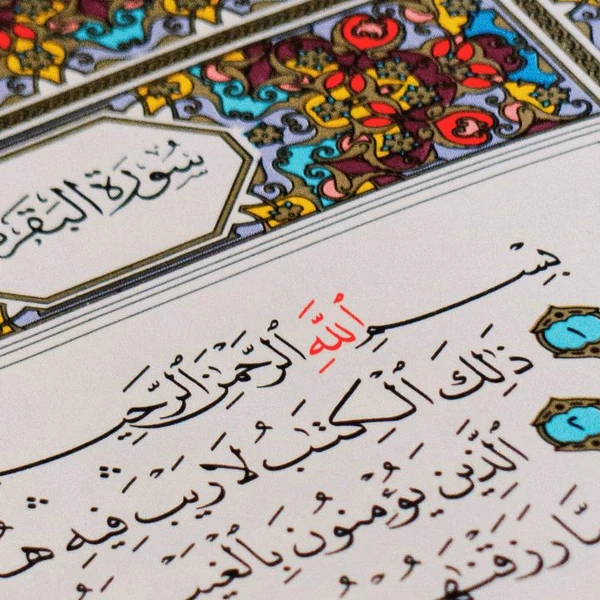
You’ve probably noticed it. Flip through the Quran and a few chapters open with the same three letters, الم, and at some point you wonder if you’re looking at the same surah twice or if the letters really do repeat. They repeat. So, what surahs start with Alif Laam Meem? Six: Al-Baqarah, Aal-Imran, Al-Ankabut, Ar-Rum, Luqman, and As-Sajdah.
What surahs start with Alif Laam Meem in the Quran?
Here’s the full list:
| Chapter | Surah | Opening |
| 2 | Al-Baqarah | الم (Alif Laam Meem) |
| 3 | Aal-Imran | الم (Alif Laam Meem) |
| 29 | Al-Ankabut | الم (Alif Laam Meem) |
| 30 | Ar-Rum | الم (Alif Laam Meem) |
| 31 | Luqman | الم (Alif Laam Meem) |
| 32 | As-Sajdah | الم (Alif Laam Meem) |
Al-Baqarah opens this way at 2:1 and Aal-Imran at 3:1. Then there’s a long gap, and the letters come back in chapters 29 through 32, four times in a row.
1. Surah Al-Baqarah (chapter 2)
Al-Baqarah is the first surah in the Quran’s order to open with الم. Those three letters are the entire first verse, 2:1. The next verse turns straight to the Book and its guidance for those who are conscious of Allah.
One thing worth knowing if you’re still learning to read: you don’t say الم as if it were a word. Each letter gets its own name. If you’re building your reading from the ground up, Iqra’s Quran Reading program walks through letter recognition, vowel patterns, and recitation at a pace that suits beginners.
2. Surah Aal-Imran (chapter 3)
Right after Al-Baqarah comes another surah with exactly the same opening. Aal-Imran begins with الم at 3:1, again as a complete verse. So after Al-Fatihah, you get two surahs back to back that start identically.
That can actually help with memorization, since you start to see the pattern. Just don’t let the shared opening blur what comes after it.
3. Surah Al-Ankabut (chapter 29)
You won’t see the letters again until chapter 29. Al-Ankabut 29:1 is just الم, and 29:2 moves into the question of people being tested after they say they believe.
This is where memorizers get caught. If someone says “الم, what’s next?”, the letters alone don’t tell you. You have to hook the opening to the verse after it. For Al-Ankabut, I’d think: Alif Laam Meem → testing faith. It’s a handy memory cue, and it doesn’t pretend the letters themselves mean anything.
4. Surah Ar-Rum (chapter 30)
Ar-Rum follows directly and opens the same way, at 30:1. The verses after it talk about the Romans having been defeated, then foretell that the defeat would be reversed. So the next cue is: Alif Laam Meem → the Romans.
Look at what’s happening across chapters 29 and 30. Same letters, completely different next verse. That’s why it’s worth practicing the jump from الم into verse two rather than memorizing the letters on their own. If you want structured help with that, Iqra’s Quran Memorization program is built around exactly this kind of work.
5. Surah Luqman (chapter 31)
Luqman does it again. 31:1 is الم, the whole verse. Now three consecutive surahs (Al-Ankabut, Ar-Rum, Luqman) start the same way, and that’s confusing if you’re memorizing them together.
The fix is simple. Learn the first two or three verses of each as one unit. Then your memory has something to grab onto besides the letters.
6. Surah As-Sajdah (chapter 32)
As-Sajdah finishes the run. 32:1 is الم, and the next verse says the revelation of the Book is from the Lord of the worlds.
So chapters 29, 30, 31, and 32 all begin with الم, one after another: Al-Ankabut, Ar-Rum, Luqman, As-Sajdah. If someone asks you which surahs start with Alif Laam Meem and you can only remember one group, remember this one.
What does Alif Laam Meem look like in Arabic?
It’s written الم. The three letters are:
- ا (Alif)
- ل (Laam)
- م (Meem)
In a printed Mushaf you’ll often see extra recitation marks around them, but the letters underneath are the same three. And again, it isn’t read as a normal word. You say the letter names one by one: Alif. Laam. Meem.
What are the huruf muqatta’at?
Openings like this belong to a group called al-huruf al-muqatta’ah, usually translated as the “disconnected” or “disjointed” letters. They’re separate letters that appear at the start of a number of surahs, and each one is pronounced on its own, not joined into a word.
Classical scholars discussed what they might mean, and they didn’t all land in the same place. Quran.com’s scholarly summary on 2:1 lays out several opinions, including the view that their ultimate meaning is knowledge Allah hasn’t disclosed to us. So be careful with anyone who confidently tells you الم “means” something specific.
Does Alif Laam Meem have an English translation?
Most English translations just write “Alif, Lam, Meem” and leave it there. That’s deliberate. These are Arabic letters, but they aren’t treated like an ordinary word you can swap for an English one.
Scholars have talked about the possible wisdom behind them, and that’s worth reading someday. But speculation isn’t certainty, and you don’t need an invented meaning to read or memorize them properly. For now, just know this: الم is three separate letters, recited as Alif, Laam, and Meem.
Is Surah Al-A’raf an Alif Laam Meem surah?
This is where online lists get messy. Al-A’raf does start with Alif, Laam, and Meem, but it doesn’t stop there. Its full opening at 7:1 is المص (Alif Laam Meem Sad).
That extra letter, ص, makes it a different opening from the six above. So the answer depends on the question:
- Which surahs begin with exactly Alif Laam Meem? Six.
- Which openings contain Alif Laam Meem as part of a longer sequence? Then Al-A’raf belongs in the conversation too.
I’d keep it in its own category and not call it a seventh. Put المص next to الم and you can see they share a start but aren’t the same opening. It’s also a good reminder to read carefully. Someone rushing through the script might stop at م, while a careful reader catches the ص right after it.
How do you pronounce Alif Laam Meem?
Say the letters one at a time, not blended: Alif, then Laam, then Meem.
But transliteration will only take you so far. Transliteration may teach you how the word is said, but it won’t give you information about the way that the Arabic letters should be pronounced and how some of their sounds should be extended. The proper way to learn would be to learn from a tutor or a Tajweed course.
Why do some lists give different numbers?
Because people count different things. One list sticks to the exact sequence الم and gets six. Another throws in Al-A’raf because المص begins with the same first three letters, so you end up with someone saying “six” and someone else talking about a bigger Alif-Laam-Meem family.
If you want the clean answer: six surahs start with the exact three-letter opening الم. Al-A’raf starts with a related but longer sequence, المص, so mention it separately and don’t count it among the six.
How the six are arranged (and an easy way to memorize them)
They’re not scattered at random. They sit in two groups:
- Early pair: chapters 2 and 3 (Al-Baqarah, Aal-Imran)
- Later group of four: chapters 29, 30, 31, and 32 (Al-Ankabut, Ar-Rum, Luqman, As-Sajdah)
So the numbers are 2, 3, then 29, 30, 31, 32. That’s far easier to hold onto than six unrelated names. Learn the numbers first, then attach each surah name to its number. Once that feels familiar, stop reciting the list and open each surah to read its first few verses. The list is just trivia until you’ve actually seen what follows.
Don’t memorize only the letters
Here’s the problem with memorizing these surahs: six chapters share one beginning. If someone says “الم, what comes next?”, it could be any of the six. Without context you’re guessing.
So pair each opening with what comes right after it:
- Al-Ankabut: the next verse is about people being tested.
- Ar-Rum: the next verse is about the Romans’ defeat.
- As-Sajdah: the next verse is about the revelation of the Book.
Now one shared opening has become six separate paths.
A good test is to work backwards. Have someone read you only the verse after الم and try to name the surah. It exposes gaps that normal recitation hides. You can recite a surah perfectly from the start because muscle memory carries you, then freeze when asked which Alif Laam Meem surah you’re in. Practicing the transitions fixes that.
Do all the Alif Laam Meem surahs discuss the same topic?
No. Sharing an opening doesn’t mean they repeat the same subject. Al-Ankabut moves from الم straight to whether people will be left alone after saying they believe. Ar-Rum goes into a specific historical situation involving the Romans. As-Sajdah opens by affirming that the Book is revealed by the Lord of all worlds.
It would be misleading to pick one topic and say every surah starting with الم is “about” it. Each one needs to be read in its own context.
Should you try to decode Alif Laam Meem yourself?
It’s natural to wonder. Muslims have been discussing these letters for centuries. But wondering isn’t the same as knowing.
Classical scholarship offers several interpretations, and one prominent view is that their true meaning is known only to Allah. There’s a real difference between studying what scholars have said and claiming that one speculative reading is definitely what Allah intended. The first is valuable. The second goes further than anyone can safely establish.
For most readers, the better place to start is the practical stuff: how the letters are recited, where they appear, and what the verses after them say.
What’s the easiest way to study these surahs?
Start with the Quran itself, not with the letters in isolation. Here’s a simple routine:
- Open one of the six surahs.
- Read الم aloud.
- Read the next two verses.
- Write down the surah’s name and chapter number.
- Close the Mushaf and try to recall what follows الم.
- Repeat with the next surah.
- When all six feel familiar, shuffle the order.
This makes the trivia question an actual study of the Quran, and prevents the most common mistake of remembering the same opening but forgetting which Surah is being read.
Quick reference
If you just need the answer, here it is.
Surahs beginning with exactly الم:
- Al-Baqarah
- Aal-Imran
- Al-Ankabut
- Ar-Rum
- Luqman
- As-Sajdah
Keep this one separate: 7. Al-A’raf, which opens with المص (Alif Laam Meem Sad).
The memory formula: 2, 3 + 29, 30, 31, 32.
Frequently asked questions
How many surahs start with Alif Laam Meem?
Six: Al-Baqarah, Aal-Imran, Al-Ankabut, Ar-Rum, Luqman, and As-Sajdah.
What are the six Alif Laam Meem surahs?
Surahs 2, 3, 29, 30, 31, and 32, which are Al-Baqarah, Aal-Imran, Al-Ankabut, Ar-Rum, Luqman, and As-Sajdah.
Does Surah Al-A’raf start with Alif Laam Meem?
It starts with those three letters, then adds Sad. Its full first verse is المص (Alif Laam Meem Sad), so it isn’t one of the six exact الم openings.
What does Alif Laam Meem mean?
Scholars have offered different interpretations of the disconnected letters. A well-known position is that their ultimate meaning is known to Allah. They shouldn’t be given a fixed, invented translation.
Is Alif Laam Meem one Arabic word?
No. It’s three letters (Alif, Laam, and Meem) pronounced individually, not as a single word.
Which is the first surah that starts with Alif Laam Meem?
Al-Baqarah, chapter 2. Its first verse is Alif Laam Meem.
Which four consecutive surahs start with Alif Laam Meem?
Al-Ankabut (29), Ar-Rum (30), Luqman (31), and As-Sajdah (32).
How is الم pronounced?
By naming the three letters one at a time: Alif, Laam, Meem.
Conclusion
So, what surahs start with Alif Laam Meem? Six: Al-Baqarah, Aal-Imran, Al-Ankabut, Ar-Rum, Luqman, and As-Sajdah. The easiest way to keep them straight is by chapter number: 2, 3, 29, 30, 31, 32. Just keep Al-A’raf apart, since it opens with Alif Laam Meem Sad (المص), not الم alone.
But the list is only the beginning. Go through each surah and start reading the opening verses. It’s this step that gives the six a unique identity instead of an identical opening.