


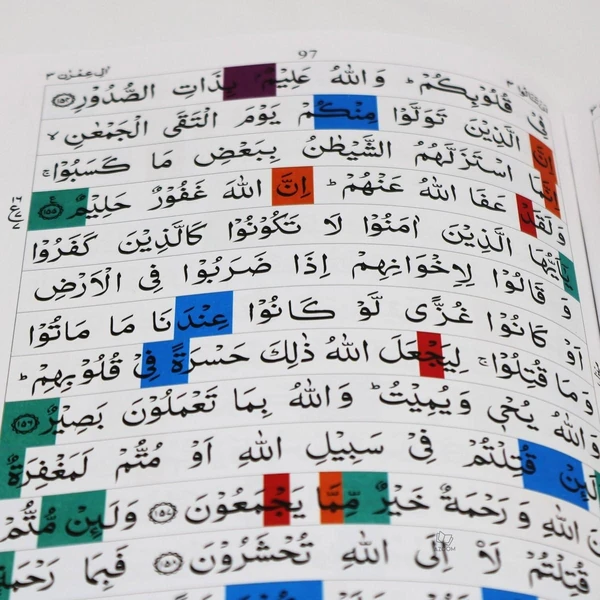
What is a Tajweed Quran? It’s a normal copy of the Quran with built-in hints for reciting it properly. Some editions use colors, some use little symbols, some add notes in the margin. They tell you where to stretch a sound, where two letters blend, where the nasal tone comes in, where to slow down. If you’re a beginner, that’s a lot of guessing taken off your plate.
What does “Tajweed” mean?
The word comes from the Arabic تجويد, and the root has to do with doing something well. In recitation, it means the rules for pronouncing each letter and word the right way. Where a letter comes from in your mouth or throat. What gives it its character. When a sound gets longer, when two sounds melt together, when the nasal tone kicks in, and where you can stop for breath.
It doesn’t touch the Quran itself. Tajweed adds nothing to the text. It only decides how you say what’s already there.
Allah tells the Prophet ﷺ in Surah Al-Muzzammil:
“And recite the Quran properly in a measured way.” (Quran 73:4)
The Arabic word is tarteel. Slow, careful, unhurried.
So what exactly is a Tajweed Quran?
Same Quran. Same verses, same order, nothing rewritten. Only the page looks different.
Most Tajweed mushafs have colors for specific rulings. Thus, instead of having to first memorize and then go looking for it somewhere within the ayah, there it is right beside the word. In one such mushaf, rulings such as madd, ghunnah, ikhfa, idgham, iqlab, qalqalah, and select few letters are highlighted.
Here’s the catch: there’s no universal color code. One publisher’s red is another publisher’s green. Flip to the key at the front of your mushaf before you read a single line.
Is a Tajweed Quran different from a regular Quran?
Not in the text. Both have the same Arabic. The Tajweed edition just adds learning aids on top.
| Regular Quran | Tajweed Quran |
| Same Arabic text | Same Arabic text |
| Standard vowel marks | Standard vowel marks plus Tajweed cues |
| You spot the rules yourself | Colors or symbols point them out |
| Fine for experienced readers | Usually easier for beginners |
Neither one changes the revelation. The Tajweed copy is a teaching tool, that’s all.
Why do Tajweed Qurans use different colors?
Because a pronunciation rule is invisible until someone marks it.
Picture a verse with a vowel that’s supposed to be held longer. If you’re new, you’ll roll right over it. A colored letter stops your eye.
Do that for a few weeks and something nice happens. You start noticing the same pattern on plain pages with no color at all. But keep in mind the color isn’t the rule. It’s a sticky note. Sooner or later you want to know why the sound changes, not just that a letter turned orange.
What do the colors in a Tajweed Quran mean?
Depends on the publisher, so read the legend. Typically you’ll see colors for:
- Madd: holding a vowel for the right number of counts
- Ghunnah: the nasal sound
- Ikhfa: partly hiding noon sakinah or tanween in certain situations
- Idgham: blending one sound into the next under certain conditions
- Iqlab: changing how noon sakinah or tanween sounds before the letter ب
- Qalqalah: the echo on certain letters when the conditions are right
Never assume green means the same thing across two mushafs. It doesn’t.
Does a Tajweed Quran teach you Tajweed on its own?
No. And I’d rather you hear that now than six months in.
The colors tell you where a rule applies. They can’t tell you what it sounds like. A letter marked for ghunnah says “nasalize here.” It doesn’t say how strong, how long, where your tongue goes, or whether you’re even doing it correctly. That part comes from listening, and from someone who can listen to you.
If you want the rules taught alongside guided pronunciation, Iqra’s Tajweed course is built for exactly that.
Why correct pronunciation matters
Muslims don’t treat Quran recitation like reading a novel. Allah commands measured recitation in 73:4, and learning the Quran holds a special place in the Prophet’s teaching. Uthman ibn Affan رضي الله عنه narrated that the Prophet ﷺ said the best among the Muslims are those who learn the Quran and teach it (Sahih al-Bukhari 5027).
None of that means you must sound perfect before you open the book. Learning is part of the deal.
What if you keep making mistakes?
Keep reading anyway.
Aisha رضي الله عنها narrated that the Prophet ﷺ described the person skilled in the Quran as being with the noble and righteous recording angels. He also said that whoever recites it while struggling and finding it hard receives two rewards (Sahih Muslim 798a).
That should take some pressure off. You’ll pause in weird places. You’ll forget a rule you learned last week. You’ll mix up two Arabic sounds that seem identical to you. You’ll read the same verse ten times and still stumble on the third word. All of that is normal, and none of it is a reason to quit. A Tajweed Quran makes practice easier, but it doesn’t make it fast.
Which Tajweed rules will you see marked?
You don’t need all of them on day one. But knowing the names helps you make sense of what’s on the page.
Madd
Madd is lengthening a vowel. How long depends on the letters around it. At the start, don’t worry about the categories. Just train your ear to catch the difference between a normal vowel and one that’s being held on purpose.
Ghunnah
A nasal sound tied to noon and meem in certain forms. Don’t stretch it at random. One good recording of a skilled reciter will teach you more than a paragraph of definitions.
Ikhfa
Concealment. With noon sakinah or tanween in the right setting, the noon isn’t fully clear, but it isn’t swallowed by the next letter either. It lives somewhere in the middle, which is why this one is mostly learned by ear.
Idgham
Merging. When certain letters come after noon sakinah or tanween, the two sounds blend according to set rules. Some versions keep the ghunnah. Some don’t.
Iqlab
Changing. Noon sakinah or tanween before ب turns into a meem-like nasal sound. A lot of mushafs print a tiny meem above the letter so you don’t miss it.
Qalqalah
Five letters: ق ط ب ج د. Students memorize them with the phrase قطب جد. When the conditions are right, the sound gets a slight echo or bounce. It shouldn’t turn into a whole extra vowel.
Are Tajweed symbols the same as harakat?
Wrong. The harakat are the fundamentals: fathah, kasrah, dammah, sukoon, shaddah, tanween. Everything is built upon that. The tajweed symbols come on top to show how sounds act in connection with each other.
You need both skills. Letters and vowel marks first, then Tajweed polishes how you say it all.
If you’re still shaky on the basics, Iqra’s Quran reading programis the better starting point.
Do you need to know Arabic to use a Tajweed Quran?
You don’t have to speak it. Plenty of Muslims recite beautifully long before they can order a coffee in Arabic.
But you do need to read it, at least at a basic level: the letters, their different shapes, short vowels, sukoon, shaddah, tanween, and how words join. If you’re still stopping at almost every letter, piling Tajweed on top will feel awful. Get the foundation down first, then add rules a few at a time. Not the whole textbook in one sitting.
Can beginners use a Tajweed Quran?
Yes. Honestly, beginners get the most out of it. The colors give you something to grab onto. Just do things in a sensible order:
- Learn the Arabic alphabet.
- Learn how letters connect.
- Get comfortable with harakat.
- Read simple words.
- Work on where each letter comes from.
- Add basic Tajweed rules.
- Practice them from the mushaf.
- Read to someone who can correct you.
Skip the early steps and Tajweed gets harder than it needs to be.
Can children learn from a Tajweed Quran?
They can, as long as the material fits their reading level. A bright, colorful page can help a child notice rules. Too many colors and too many rules at once and it falls apart.
Good teachers usually go one thing at a time. One articulation point. One madd pattern. One ghunnah example. One short passage. Then, once that sticks, the next.
If you’re a parent who wants real guidance for your child, take a look at Iqra’s Quran classes for kids. Don’t hand a kid a colored mushaf and expect them to figure out the whole system alone.
Can adults start Tajweed from scratch?
Of course. You don’t need to have learned it as a kid.
Some adults already read the Quran but realize later they’ve picked up habits they’d like to fix. Some are learning the language for the first time. Whatever the case may be, here are some tips: taking it slow, explaining the origin of each letter, reading small passages repeatedly, recording oneself and listening, comparing one’s voice with that of the teacher, and correcting one mistake at a time.
Iqra’s adult Quran learning program was designed for adults, not borrowed from a children’s curriculum.
Can you learn Tajweed just by listening to reciters?
Listening helps a lot. It just doesn’t finish the job.
The reciter will demonstrate the rhythm, the prolongation, the articulation, the stops, and the linkage of the words. Try it for yourself: read the verse, listen to the reciter, and repeat the verse.
What listening can’t do is explain why your version is off. You can hear the right sound perfectly and still produce something different. A teacher closes that gap.
Why you still need a teacher
Some mistakes are almost impossible to hear in your own voice. You might be sure two letters sound different when you’re pronouncing them nearly the same.
A teacher catches things like articulation points (makharij), letter characteristics, too much or too little madd, a wrong ghunnah, qalqalah, heavy and light letters, where you stop and start, and the rules between connected words.
Think of the mushaf as the road sign. The teacher tells you if you’re actually on the road.
If you want that kind of correction, you can study with one of Iqra’s Quran teachers instead of going it alone.
How to practice with a Tajweed Quran
Don’t open a long surah and try to apply every rule at once. You’ll burn out by the third line. Try this instead:
- Pick a short passage that fits your level.
- Read the color key. Don’t guess what the colors mean.
- Choose one rule, say madd, and find every example on the page before you read aloud.
- Listen to a correct recitation, paying attention only to that rule.
- Read slowly. Accuracy first, speed never. Quran 73:4 points toward measured recitation, not racing.
- Repeat the verse until it feels easier.
- Read it to a teacher if you can, then go back and apply what they told you.
Should you memorize the rules before you start reading?
Usually not. If you wait until you’ve finished all the theory, Tajweed becomes a vocabulary list instead of something you actually do with your voice. A better loop is: learn it, hear it, read it, get corrected, repeat.
Take qalqalah. Learn the basic rule. Find it in a few verses. Listen to how those words are recited. Practice them. Ask your teacher to fix what’s off. When it feels natural, move on to the next rule.
Nobody’s going to quiz you on the word “qalqalah.” What matters is getting the sound right when it shows up in a verse.
Tajweed Quran vs transliteration Quran
They solve different problems. A Tajweed Quran marks pronunciation rules inside the Arabic text. Transliteration writes Arabic sounds in Latin letters.
Transliteration can give you a rough idea in the first few days. After that it holds you back, because English letters just can’t capture every Arabic sound. These, for example, have no real English equivalent:
ع ح خ ص ض ط ظ ق
If you’re serious about recitation, learn the Arabic script. Don’t lean on transliteration forever.
Tajweed Quran vs translation Quran
A translation helps you understand what the verses mean. A Tajweed Quran helps you recite the Arabic correctly. Two different jobs.
Some editions try to do everything: Arabic, Tajweed colors, English translation, transliteration, notes. Convenient on paper. But if a page gets so crowded that the Arabic is hard to read, it’s working against you. Pick the format that fits what you’re trying to do right now.
How to choose a good Tajweed Quran
Before you buy, check a few things.
Look at the color legend. Can you tell what each color means? Look at the Arabic font, because some scripts are far easier on the eyes than others. Check the text size. Tiny print wears you out. If you have a teacher, find out which edition they use, since matching page layouts makes lessons smoother.
And don’t buy the prettiest one just because it’s pretty. A gorgeous mushaf isn’t automatically a good learning copy. If the page feels busy or overwhelming, a simpler edition is probably better for you.
Should you always use a color-coded Quran?
No. It’s a learning aid, not a permanent crutch. With steady practice, you should start spotting rules from the letters alone.
Reach for the colored mushaf when you’re learning a new rule, practicing by yourself, refreshing something you forgot, or preparing a passage for a lesson. Then, every so often, read from a plain mushaf. That’s how you find out whether you learned the rule or just memorized a color.
Can Tajweed help with memorization?
It does. Accurate pronunciation gives each verse a steady sound, and a word you’ve memorized wrong is stubborn to fix later. So it pays to read carefully from the very start.
Listen to the verse, follow it in your mushaf, spot any Tajweed points you don’t know yet, recite slowly, and fix errors before the heavy repetition begins. Then start memorizing.
If Hifz is your main goal, Iqra’s Quran memorization program pairs memorization with supervised recitation.
Common mistakes when using a Tajweed Quran
- Relying on colors alone. “Red means stretch” isn’t understanding. Learn what the rule actually does.
- Reading too fast. Speed hides pronunciation problems.
- Copying audio without knowing why it sounds that way. Listening is great, but pair it with real instruction.
- Ignoring makharij. You can nail madd and ghunnah and still get a letter wrong if it comes from the wrong place.
- Trying to learn ten rules at once. Smaller steps.
- Dodging correction because it’s embarrassing. Mistakes are part of learning, and Sahih Muslim 798a gives real encouragement to the reader who struggles.
Frequently asked questions
What is a Tajweed Quran in simple words?
It’s a Quran that uses visual markings, usually colors, to help you spot recitation rules while you read the Arabic.
Is the Tajweed Quran different from the Quran?
No. The text is exactly the same. Tajweed editions only add teaching aids like colors, symbols, or a key.
Is a color-coded Quran good for beginners?
Yes. It helps you notice rules faster, especially when you also listen to recitation and get corrected by a teacher.
Do all Tajweed Qurans use the same colors?
No. It varies by publisher, so check the legend in your own mushaf.
Can I learn Tajweed without a color-coded Quran?
Yes. A standard mushaf works fine with proper instruction. The colors help, but you don’t need them.
Can I learn Tajweed by myself?
You can learn the terms and practice on your own. But a qualified teacher is the best way to catch pronunciation and articulation mistakes you can’t hear yourself.
Do I need to speak Arabic to learn Tajweed?
No. You can learn to recite without conversational Arabic, though you do need basic reading skills.
What should I learn before Tajweed?
Arabic letters, their connected forms, short vowels, sukoon, shaddah, tanween, and basic Quran reading. Then the rules.
Is Tajweed only about reading slowly?
No. Slow reading helps you practice, but Tajweed also covers articulation, letter characteristics, lengthening, nasalization, merging, stopping rules, and more.
Why is Tajweed important?
It helps you pronounce the Quran carefully and accurately, and Quran 73:4 specifically instructs measured recitation.
What if Tajweed feels hard?
Keep going a little at a time. Sahih Muslim 798a mentions a double reward for the person who recites the Quran while struggling with it.
Is a Tajweed Quran useful for memorization?
Yes. It lets you notice pronunciation rules before you repeat a verse so many times that a mistake sticks.
Conclusion
So, what is a Tajweed Quran? It’s the Quran with visual cues that help you catch recitation rules as you read. The colors make unfamiliar rules easier to see, but they’re only one piece.
Start with a mushaf you can read comfortably. Go slow. Listen closely. Get corrected when you can. Learn one rule, use it in real verses, then move to the next. It gets a lot less scary that way.